Showing posts with label Textbooks. Show all posts

16 August 2024

Digitising Old Textbook Exercises

I have a pretty extension collection of old maths books. They’re very cheap to pick up in second hand bookstores, and the only thing stopping me from buying them all the time is the lack of space in my house!


I was browsing through ‘A New Course in Algebra’ this morning. It’s from 1959, so not particularly old compared to some other textbooks in my collection. It’s full of long algebra exercises with tonnes of challenge. I’m not suggesting we use these exercises in their entirety (I may be old fashioned, but even I draw the line at giving my students fifty sets of double brackets to expand!). But they do provide some nice ideas, particularly for extension questions.


I've blogged about the treasures I've found in old textbooks many times before (for example in my post about Elementary Algebra for Schools), and once I even had a team of teachers type up some of the exercises. I also have page on my blog where teachers can access online versions of old textbooks, going back to the 1500s. 

Today I thought I’d try something different. I took some pictures of exercises and tried converting them to PDFs using mathpix.com.

I didn't really know what to expect, but the quality of the output blew my mind! 

I randomly took some photos of pages from the textbook on my phone. I uploaded them to Mathpix and it instantly converted them to very high quality electronic versions. I'm shocked that it was able to read the pictures so well! Below are my initial attempts (note that I was randomly taking photos of various pages in the book, hence these aren't full exercises).

Here's the first photo I took:


And here's what Mathpix gave me. It is spot on.


I tried something which I thought might be harder to read (the indices in the textbook are a bit blurry):


But it had no trouble with this at all (this is an extract from this exercise - I have rearranged it in Word. I love these questions...)


I wondered if it could cope with surds and the answer is yes. 


This exercise on expanding double brackets came out clearly too. 


Compare this exercise with equivalent exercises in modern textbooks. So much thought has gone into it. I suspect that many modern day Key Stage 3 'top set' classes just practise the basics of expanding double brackets and then move on, instead of being given the opportunity to really strengthen their algebraic fluency by attempting questions like these.


And one final example - solving quadratic equations. 


Again, Mathpix converted it perfectly. Again, there are some great questions in this exercise.

Just as I got very excited about all this, I realised that Mathspix limits me to only ten free snips, and I used them all very quickly...

But it's so interesting to see that there's huge potential here to make very useable versions of some these old exercises. And yes - the answers are at the back of the book! So they could be converted too.


27 July 2021

5 Maths Gems #146

Welcome to my 146th gems post. This is where I share some of the latest news, ideas and resources for maths teachers. 

1. Pythagoras 
Teaching Pythagoras was one of the highlights of the year for me. What an awesome topic. Thank you to @giftedHKO for sharing some lovely Pythagoras tasks on her blog - I look forward to using these next year.


In case you missed it, do check out @Mr_Rowlandson's recent blog post Playing With Pythagoras and Trigonometry which features lots of clever ideas.

2. CIMT Textbooks
I've made heavy use of CIMT textbooks since my PGCE. I own physical copies but when planning lessons I usually download the CIMT resources from TES, where they are in neat bundles along with the answers. The challenge is working out which bundle to use. Though they are organised by topic, sometimes it would be helpful to be able to search through all the resources. Thankfully, @nathanday314 has come to the rescue by merging all the CIMT practice books into one searchable, fully-indexed, 2100 page PDF. Thanks Nathan!


3. Surds
After a couple of years of only teaching Key Stage 3, my school has finally grown to the point of having GCSE classes! Hurrah. We'll be starting Year 10 with surds, and I like this introduction from @JaggersMaths.


For more ideas for teaching surds, checking out my surds in depth workshop.


4. Problems
Thank you to @SarahFarrellKS2 for sharing a PDF document of her first hundred #dailymathspuzzle questions. These are designed for Key Stage 2 students but would be suitable for many Key Stage 3 students too.


I've added this link to my problem solving page which features collections of problems and puzzles.


5. Powers and Roots
I'm always a fan of @MrDraperMaths's blog posts. His latest post focuses on powers and roots and is packed full of great tasks.


Update
Term ended on Friday for me and I now have five weeks to recover (and, sadly, catch up on the vast amount of student timetabling work I didn't get time to do before the end of term). This year was unbelievably brutal. To those of you who contacted me through Twitter or email in the summer term and didn't get a reply: I'm incredibly sorry. My role got totally out of control for a while there, and I failed to keep on top of anything outside of work. I'm hopeful that things will improve next year. 

In case you missed it, do check out Jemma Sherwood's (@jemmaths) excellent post 'Consistency and Autonomy', which follows on from some ideas I wrote about in a blog post back in May.

Also have a read of Anne Watson's latest post in the Dose of Don series. This post explores Don's thinking around angle bisection. 

If you're looking to spruce up your classroom or corridors this summer, you'll find loads to choose from on my displays page.

I can't wait to get my own classroom back. I'm sure many teachers feel the same. On the first day of the holidays I took my daughters into school (always a treat for them!) and they helped me clear out all the rubbish left in there by the various nomadic teachers who used it over the course of the year. I'm much happier now it's all sorted. I'm not fussy about pretty displays but I do like a splash of colour to brighten up a dreary room, so I used Sarah Carter's maths symbols display to cover a blank board (no backing, borders or laminating so it was a five minute job - and I'm not bothered that it's a bit wonky!). I've moved the desks away from the wall to stop students ruining it.
After an exhausting year which has left me feeling totally defeated, spending an hour preparing my classroom has cheered me up and made me look forward to September.

Nothing special, but I can't wait to get my classroom back!


Thank you to Kyle Evans for sending me a copy of his new book Maths Tricks to Blow Your Mind. My daughters are doing a swimming crash course this week and this makes perfect reading while I'm waiting for them by the pool!


I'm off on holiday with my family on Monday, and I will do my very best to switch off completely for two weeks. Have a lovely summer everyone!


4 April 2019

5 Maths Gems #108

Welcome to my 108th gems post. This is where I share some of the latest news, ideas and resources for maths teachers.

1. SMP
Christian Bokhove (@cbokhove) and his team have been working on this project for a while so it's exciting to see the launch of smp2.co.uk. They have created PDFs of dozens of old SMP maths textbooks and booklets. Read about the aims of the project here.

Click ‘Access to SMP’ to register and download the materials. It's free and there's absolutely loads of material to look through. It's hard to know where to start! I'm very grateful to those involved for all their hard work on this.

Here's a randomly picked example of a task on calculator use. It's from Book G1.
And here's part of a task from a Level 3 booklet 'Coordinates 2 - Extension'.
2. Storyboarding
Thank you to Dale Chapman (@MrChapmanMaths) for sharing his storyboarding idea. This is where students create a simple set of instructions with pictures to explain a procedure. I blogged about a really similar idea for teaching constructions in Gems 30 back in 2015, but subsequently forgot all about it so this is a great reminder! Plus it's good to see it in use for bearings, and I wonder what other topics would lend themselves well to storyboarding.

3. GCSE Revision
As always at this time of year there's been a flurry of new revision resources.
  • Simply Effective Education sells Key Cards, which is (in my opinion) the best GCSE revision app available for maths and science. They have also shared some free revision races on TES
  • I was asked to make a PowerPoint to accompany Mr Knowles' (@SK18Maths) Foundation algebra revision booklet . It was designed to be used in short daily form time interventions but can be used in longer revision lessons too.
 

4. Fill in the Gaps
At Educating Northants last week Craig Barton (@mrbartonmaths) shared a new type of resource: Fill in the Gaps. We had a go at it during the workshop and it was brilliant. Try it and you'll see what I mean.
Go to variationtheory.com to download this ratio task, plus one for percentages and one for quadratics.

5. A Level Resources
Tom Bennison (@DrBennison) shared a 'Question a Day' revision resource for Year 13. 

@MrsGRVHS shared a padlet for A level maths with links to resources and useful websites.

@naikermaths added another AS Pure Practice Paper to the collection. These papers contain old specification exam questions but they are organised for the new specification so they are helpful for revision. The mark schemes for these AS Practice Papers can now be accessed without a password to help students in their revision for their A level exams.

Finally, while looking at MEI A level things on OCR's website, I discovered this command words summary. I have added this to my displays page.

Update
I've been to three lovely conferences in the last two weeks - Habs Girls, Educating Northants and the London Thames Hub Primary Maths Conference.
At Educating Northants I recorded a Conference Takeaways podcast with Craig Barton that you can listen to here.
I also went out with my friends Gill Leahy and Dil Dias from the London Thames Maths Hub to see Hannah Fry do a talk about her book Hello World. It was brilliant.
During Educating Northants I went to a workshop on primary mastery by Nicky Moksa and she shared this grid of number facts. You can read more about it on the NCETM website here and here.

I have made quite a few updates to my conferences page lately - there's always a lot going on in the summer term. I'm looking forward to speaking at the Kent and Medway Secondary Maths Conference on Monday 8th July.

Nikki Martin (@nikki_nzmartin) completed her work on the Primary Topics in Depth project. This series of packs feature maths misconceptions, approaches and resources for Years 1 - 6.

My daughters discovered Sumaze Primary last week which was awesome - my 7 year old was totally in love with it and really happy when she completed every level. It's an amazing maths app for young children.

I look forward to seeing lots of you at the ATM/MA conference which is coming up soon. Before then, I'm very much looking forward to some time with my family to recover from the hectic month of March.

Finally, I'll leave you with the exciting news that Desmos now does box plots! If you haven't seen this before then do have a play.


16 September 2018

5 Maths Gems #94

Welcome to my 94th gems post. This is where I share some of the latest news, ideas and resources for maths teachers.

1. Resources Padlet
There's a huge number of maths resource websites available and it can be hard to keep track of them all. Thanks to Hannah (@missradders) for sharing a Padlet of resource websites which is well organised and really easy to use. There may be some websites here that you've not seen before so do explore. It's a good idea to make this your homepage at work for quick access, or if you're unable to do that then perhaps put a link on your desktop.
To see recommended resources for specific topics, check out my resource libraries.

2. Puzzles
If you're a fan of maths puzzles and have a Twitter account, I recommend following Catriona Shearer (@Cshearer41) who has been sharing lots of really lovely problems for you and your students. Here's an example:

"The square, circle and triangle are stacked inside a larger square. What’s the area of the circle?"
There are loads more delightfully challenging and beautifully hand-drawn problems like this on Catriona's Twitter feed.

3. A Level Resources
There has been a flurry of new A level resources lately. CrashMaths (@crashMATHS_CM) has published some really helpful resources including a proof worksheet and some practice exam papers. Also check out their ten 'AS Maths Key Skills Check' sheets which can be used to test your Year 13s on Year 12 content.
A level teachers might also be interested in this excellent Scheme of Work for A level Maths from the Oxfordshire Mathematics Community.

Stuart Price (@sxpmaths) has published a new website of A Level Maths Question Packs full of great sets of questions organised by topic.

Naikermaths (@naikermaths) has published AS Practice Papers that can be used for homeworks or internal tests.

Desmos.com (@Desmos) has released a new activity: Functions and Their Derivatives.

Don't forget that I've updated my A level resource libraries for Year 12 Pure, Year 13 Pure, Statistics and Mechanics.

4. Global Maths Textbooks
If you're interested in how maths is taught in other countries then you should follow @literallyjustq for fascinating tweets and blog posts. It's so interesting to peek into maths textbooks from all over the world. Here's an example of an exercise in a primary textbook from Timor-Leste:
And here are some fraction questions from a Grade 6 maths textbook from Kyrgyzstan:
And some order of operations practice from the UK in 1976:
Follow @literallyjustq for lots more like this.

5. Multiplication
Thanks to Ashley Booth (@MrBoothY6) for sharing a multiplication knowledge organiser which sets out the reasoning behind related calculations.
Ashley suggested using 'what else do I know? activities for students to explore related calculations.
Clare Sealy (@ClareSealy) suggested that the knowledge organiser could also be used as a matching exercise.

Updates
I am so pleased to announce some more exciting additions to my upcoming #latemaths event. The ThinkMaths team (Matt Parker, Katie Steckles and Zoe Griffiths) will be there, as well as members of the Chalkdust team. The wonderful Ben Sparks will be speaking, and we will be launching Ed Southall and Vincent Pantaloni's new book More Geometry Snacks. It's going to be fantastic. Read Ed's post for more on this, and book your ticket now!
In case you missed it, my recent blog posts were Summer Updates, in which I ran through all the new stuff you'll find on resourceaholic.com and Year 7 Maths Activities in which I featured some lovely activities that you could use in a first lesson, or any lesson, with Year 7.

Here are some other updates that you might have missed:
  • How do you factorise harder quadratics? I've blogged about the history of the two most popular methods (inspection and grouping) on La Salle's website ahead of my #mathsconf17 workshop.
  • MathsPad subscribers will have seen lots of great new resources in their September update, including a lovely nets of a cube interactive tool.
  • Mark McCourt published the third instalment of his epic series of posts on Teaching for Mastery. It's a must read for maths teachers.
  • If you are a primary teacher do check out the new Topics in Depth packs by Nikki Martin that have been published for Year 3, 4 and 5 maths topics. Also, don't forget to sign up for the upcoming Primary Maths Challenge!  
  • If you're coming to #mathsconf17 and staying overnight on the Friday then lots of us are staying in the Premier Inn Birmingham New Street. I tweeted this back in August but you might have missed it. Watch this space for news on the location of pre-conference drinks. For more upcoming events, see my 2018/19 conferences page.

Don't forget you can subscribe to my blog posts by email or follow my Facebook page for regular updates.

I'll leave you with this awesome "Mathematicians for All, Equality, Unity..." poster, created by Kate Poirier(@realKatePoirier) and tweeted by Christopher Drupieski (@christopherdrup).


15 July 2018

A Look Back at Surds

This year I've written a number of posts about maths textbooks from the last 300 years. Buying and reading historical maths textbooks has fast become my favourite hobby - it's fascinating, and it has done a lot for developing my subject knowledge this year.

Subject knowledge for maths teachers isn't just about being able to do the maths - that's the easy bit - it's also about knowing how to explain concepts clearly, knowing multiple methods and approaches, knowing common misconceptions, knowing history, etymology, narrative and so on. So, in the interest of subject knowledge development, today I bring you some maths from the past. I'm focusing on surds here (because everyone loves surds!), and I hope to bring you similar posts about other topics over the coming months.

Definitions
In Elementary Algebra for Schools (Hall & Knight, 1885), the chapter entitled 'Elementary Surds' starts with some definitions:

Whether we'd still classify those algebraic terms as surds is debatable, but otherwise the wording of the definition ('when a root cannot be exactly obtained') has been pretty consistent over the years. Here it is again in 'A Shorter Algebra' (Baker & Bourne, 1927):
The book later goes on to refer to 'surdic expressions' - I've never used the word surdic and I'd like to see it back in common usage!
In 'The Essentials of School Algebra' (Mayne, 1961) we have the following definition of surd, which offers more clarity by providing a few examples and non-examples:
All three books explain what is meant by the 'order' of surds. There are exercises on transforming surds of different orders into surds of the same order - something that we don't do in secondary mathematics anymore.

Note also that surds of order two were sometimes referred to as 'quadratic surds'. This is another expression that we seem to have lost from our secondary school vocabulary. We now deal almost exclusively with quadratic surds, in fact I have seen a number of websites and resources claim that only square roots can be called surds, which is just plain wrong.
Contrast the precise vocabulary and detailed definitions in old textbooks with the disappointing one line description we have in a modern day textbook (Edexcel GCSE Maths, OUP, 2016).
I wonder why textbook authors gave up on thorough definitions.

Justification
Interestingly, old textbooks claim that the use of surds isn't absolutely necessary because, with extensive number work (ie using the process of evolution to find roots), we can find the value of any surd to a suitable degree of accuracy.

Back in the days when maths was all done by hand, they were generally happy with 'accurate enough' and didn't insist on exactness. In fact in 'A Shorter Algebra' it says,

"Results in surds are only practically useful when expressed as decimals".

It seems that although surds were often used for efficient workings, numerical answers were rarely given in surd form. Here we see that rationalising the denominator is done to make numerical calculations easier, because multiplying by a decimal is easier than dividing by a decimal:
Vocabulary
Though we all know and use the phrase 'simplest form' to describe a surd that has been simplified, I'm not sure that many of us use the term 'entire surd' to describe an unsimplifed surd.
Textbooks used to feature exercises where students had to convert simplified surds into entire surds - it's rare to see exercises on this now.

The method for adding surds hasn't changed over the years. We still add 'like surds' or 'similar surds' (perhaps we more often refer to them 'like terms' though),

Adding unlike surds leaves us with a compound surd ('an expression involving two or more surds'):
And the process for rationalising hasn't changed over the last 130 years. We multiply the denominator by a 'rationalising factor'. Where necessary, the rationalising factor will be the conjugate of the denominator. We still refer to the conjugate now - it's good that at least some of the formal language has not been lost.
Of course, standard problems in the 1960s were far harder than they are now.
Exercises
I don't need to tell you that exercises used to be a lot longer and more challenging than they are in most modern maths classrooms. Here's an example of an exercise on rationalising - this one is from 1885. Note that the first ten questions are just for practising finding the product of two conjugates:

Notice the tricky typesetting of those pesky vinculums!

For comparison, modern textbooks have only half a dozen questions on the same skill.

The books I have been looking at (one from 1885, one from 1927 and one from 1961) continue with square rooting binomial surds and solving 'irrational equations'. I could include a lot more about surds here, but to keep this post to a reasonable length I will leave it there! You get the idea - a lot has changed, all except the mathematics itself.

I've recently bought loads of old textbooks from the early 1900s and am hoping to do a presentation about them at an upcoming conference (possibly #mathsconf17), so if you find this stuff interesting do come along.
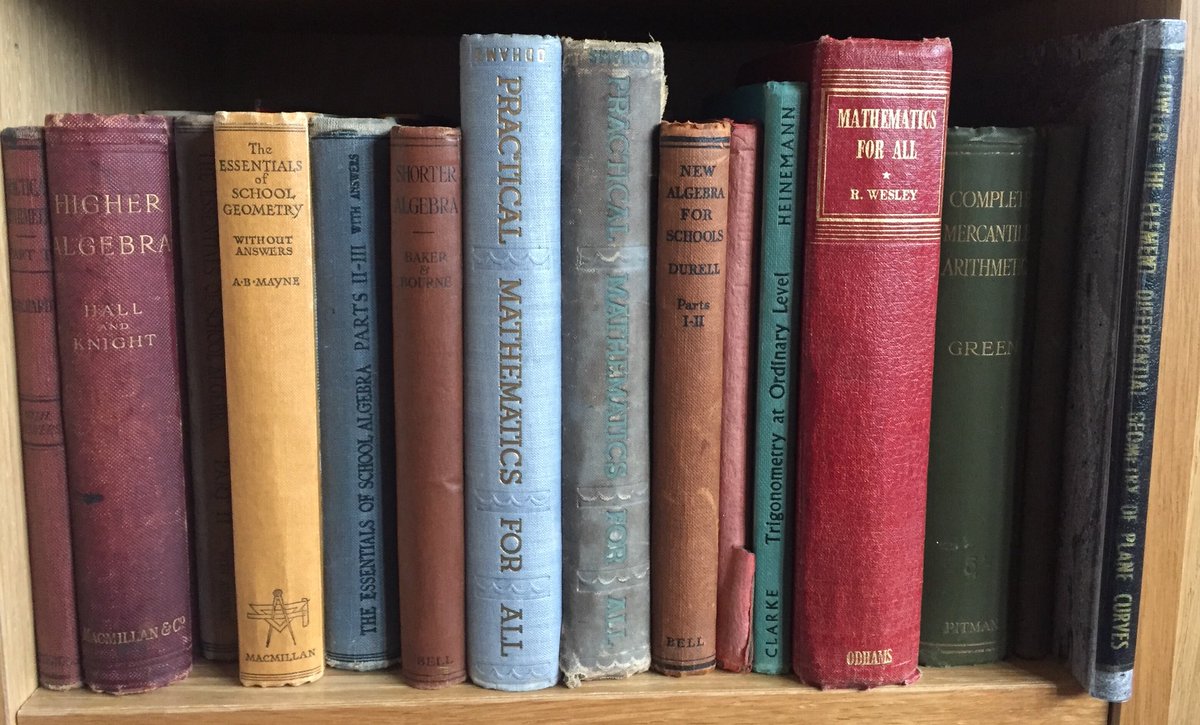
Part of my old textbook collection!
