.jpg) Twitter is a different place now everyone's back at school. During the day it's really quiet because teachers are hard at work, but in the evening it comes alive again. Despite being the first week of term, the UK maths twitter chats (#mathscpdchat on Tuesdays and #mathschat on Wednesdays) were as busy as ever - as usual they gave me plenty of inspiration.
Twitter is a different place now everyone's back at school. During the day it's really quiet because teachers are hard at work, but in the evening it comes alive again. Despite being the first week of term, the UK maths twitter chats (#mathscpdchat on Tuesdays and #mathschat on Wednesdays) were as busy as ever - as usual they gave me plenty of inspiration.This week also saw the return of teacher blogs. I really enjoy reading reflections of what teachers have been trying in their lessons, what went well and what didn't. These blogs are a fantastic source of ideas.
This fifth weekly gems post is (unintentionally) brought to you by the letter P. It features patterns, puzzles, primes, projects, plenaries and posters.
1. Patterns and Puzzles

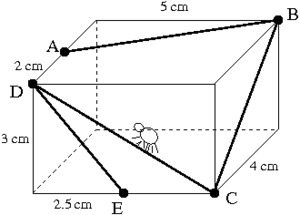
Sticking with visual maths, Denise Gaskins (@letsplaymath) shared a puzzle from the website 1001 Visual Puzzles. I explored this site and found that it's full of very unusual and original puzzles. I also learnt a little about topology - what a bizarre branch of mathematics. Here's an example of a topological puzzle (students would need to refer to a map of South America for this):

Primes are really interesting, aren't they? I've seen some great stuff on primes this week.
Richard Green (@edfromo) is a mathematician who posts regularly on Google+. He writes really interesting things about a wide range of mathematical topics. He often features animations which you'll know I'm a fan of if you read my post about animations and simulations. For example this is a very clear explanation of Mersenne primes and perfect numbers.

Richard Green (@edfromo) is a mathematician who posts regularly on Google+. He writes really interesting things about a wide range of mathematical topics. He often features animations which you'll know I'm a fan of if you read my post about animations and simulations. For example this is a very clear explanation of Mersenne primes and perfect numbers.
If you're thinking of doing something on primes with your students, @the_chalkface shared this excellent true or false activity which students will find interesting and stretching.
I also like this activity 'Further Factor Properties' from @TeachitMaths, mainly because it involves sexy primes and I'm a bit immature like that.
I also like this activity 'Further Factor Properties' from @TeachitMaths, mainly because it involves sexy primes and I'm a bit immature like that.
4. Projects
I've never thought of textbook redesign before, but it could be a really good mini-project at the end of a topic. On @JemmaPDuck's blog she says that she showed pupils a boring maths textbook and challenged them to come up with a different page on the topic they'd studied. The new page should be informative, well presented, clearly explained and contain challenging questions. I love this idea and it's perfect for peer assessment. It would also work well in a revision lesson. You could pick the best page for each topic and create a whole textbook designed by your students.
4. Plenaries
How do you end your lessons? Exit tickets? Diagnostic questions? Texts or tweets? Suffolk Maths has a helpful Plenary Review Grid with lots of good ideas.
Zoe Elder (@fullonlearning) shared this BBC article via @katiecpd '10 things we didn't know last week'. I learnt from this that Hello Kitty is not a cat! The article is worth reading every week and could be useful for tutor time. It would also make a nice plenary activity in maths lessons. Perhaps once a week students could brainstorm '10 things we didn't know last week' in terms of what they've learnt in maths. They may be surprised by how many new things they've learnt.
5. Posters
The maths periodic table display by @Just_Maths would be a fantastic addition to any maths classroom or corridor. By the sound of it, many maths teachers up and down the country have devoted a few hours of their time this week to making this awesome display. Here's a great example from Tim Jefferson (@DocendoTim).

Tom Riley (@riley_ed) shared this picture of a staircase to a maths department, which features primes, squares, cubes, times tables and formulae.

I love this post by Lois Lindemann (@MoreThanMaths) about her aims for the year, where she shared a fantastic idea - she asked students to draw portraits of their maths teachers. What a lovely way of celebrating their artistic talent.
Finally, I also spotted this excellent idea for a simple but effective message from Cristina Milos (@surreallyno). I had fun making a poster out of this message using postermywall.com.


Resourceaholic.com update
I'm really pleased to see that my blog is being used by teachers to access great resources. This week I wrote a post about teaching Pythagoras' Theorem and added a topic specials page so you can quickly find similar posts. I also had a rant about student targets in which I questioned whether they are effective or even necessary. After Ed Southall (@edsouthall) shared these awesome wall decals, I updated my mathsy gifts page. I've also added a couple more homeworks to the Pret homeworks page.

How good are you at drawing lines of best fit? Test yourself here (thanks to @MARitchings) - fun for teachers and also a useful lesson resource.
Finally - look, Spiked Math has a similar idea for name learning to the one I mentioned in my last maths gems post.

How do you end your lessons? Exit tickets? Diagnostic questions? Texts or tweets? Suffolk Maths has a helpful Plenary Review Grid with lots of good ideas.
Zoe Elder (@fullonlearning) shared this BBC article via @katiecpd '10 things we didn't know last week'. I learnt from this that Hello Kitty is not a cat! The article is worth reading every week and could be useful for tutor time. It would also make a nice plenary activity in maths lessons. Perhaps once a week students could brainstorm '10 things we didn't know last week' in terms of what they've learnt in maths. They may be surprised by how many new things they've learnt.
5. Posters
The maths periodic table display by @Just_Maths would be a fantastic addition to any maths classroom or corridor. By the sound of it, many maths teachers up and down the country have devoted a few hours of their time this week to making this awesome display. Here's a great example from Tim Jefferson (@DocendoTim).
I love this post by Lois Lindemann (@MoreThanMaths) about her aims for the year, where she shared a fantastic idea - she asked students to draw portraits of their maths teachers. What a lovely way of celebrating their artistic talent.
While I was in a creative mood, I made some posters of @joboaler's positive norms messages. As I said last week, I don’t actually have my own classroom to decorate but hopefully someone will find them useful!
I'm really pleased to see that my blog is being used by teachers to access great resources. This week I wrote a post about teaching Pythagoras' Theorem and added a topic specials page so you can quickly find similar posts. I also had a rant about student targets in which I questioned whether they are effective or even necessary. After Ed Southall (@edsouthall) shared these awesome wall decals, I updated my mathsy gifts page. I've also added a couple more homeworks to the Pret homeworks page.
How good are you at drawing lines of best fit? Test yourself here (thanks to @MARitchings) - fun for teachers and also a useful lesson resource.
Finally - look, Spiked Math has a similar idea for name learning to the one I mentioned in my last maths gems post.