Showing posts with label Indices. Show all posts

13 November 2022

5 Maths Gems #164

Welcome to my 164th gems post. This is where I share some of the latest news, ideas and resources for maths teachers.

1. Worked Examples
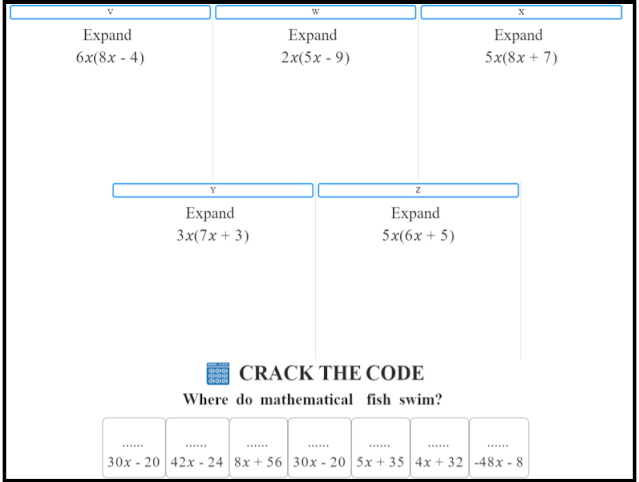
@JakeGMaths shared a large bank of worked examples. It's free to use and contains over 400 examples. Each one is several slides long, guiding students through a method in a series of steps. Then there's a printable part for the students to complete, then the solutions. The PowerPoint has clear instructions on how to use these resources in lessons. Here are a couple of examples of the student tasks:


If you haven't yet read it, I recommend Michael Perhan's excellent book Teaching Math with Examples which inspired this work.

Also check out Jake's other projects which I blogged about in Gems 158.

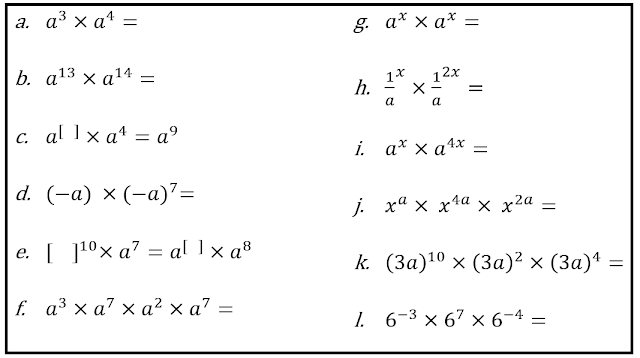
2. Operations with Negative Indices
I really like this set of questions from @karenshancock. It's a good idea to do something a bit different with negative indices, to help develop fluency whilst interleaving other skills like fraction arithmetic.


Karen kindly typed this up and shared an editable version here. I've added this to my resource library under indices. 

3. Gif Generator
@PiXLMattTheApp continues to develop his website with an incredible range of features. His latest addition is a gif creator which allows teachers to very easily create a recording of a modelled example.


I wrote about opportunities to use animated modelling in my post The Power of Modelling and Exemplars.

4. Bearings
Thanks to @DrPMaths for sharing a task linking angles in triangles with bearings. This is a building block which prepares students to be able to answer trigonometry problems with bearings - something that students often struggle with. His resource includes a few example-problem pairs and a set of practice questions with solutions.


5. Starting Point Maths
@ChrisMcGrane84 has published loads of excellent new resources on startingpointsmaths.com recently. I featured some in my last gems post, and here are a few more. 

First, a task to try before learning how to differentiate: Developing Indices Skills for Calculus.


Second, a task which has a mix of linear equations, quadratic equations, equations which look quadratic but are linear, and a sneaky cubic. Mixed Linear and Quadratic Equations is all about strategy selection, so students become better at spotting quadratics.


And finally, Odd & Even Numbers – Additive Structure - a lovely task which might be useful in primary or secondary. Read Chris's description of the task to see how he used it.


Update
At school we've all been unwell lately - it's that time of year - and our Year 11s have been in mocks so we've been doing lots of invigilation, which is pretty dull. On a more positive note, I've been teaching some of my favourite topics: Year 7 have been learning about prime numbers which is always a joy, Year 8 have been solving equations, and Year 10 have been doing quadratics.   

I'm delighted that #mathsTLP made a return last Sunday. It was an absolute pleasure to behold an hour of teachers enthusiastically sharing resources and teaching ideas. Don't forget that this now runs every Sunday at 7pm, hosted by @MissNorledge and @BrookeEHunter. You're very welcome to join in: see my blog post about how to get involved.

Here are some things you might have missed:
  • The MA is calling for submissions to lead a session at the joint subject associations conference next Easter. This two day conference at Warwick University will be the highlight of the year for maths teachers. If you're an experienced teacher with something to share, please do consider speaking. I particularly encourage female speakers, who are always underrepresented at maths education conferences. Complete this form by the end of November to offer a session.
  • Realising my Equating Coefficients in Identities task ramped up in difficulty too quickly, I made a revised version of this resource which is shared on TES. 
  • @MrDraperMaths wrote an excellent post about transformations of functions which featured a really interesting approach that had never occurred to me before.
  • @sxpmaths shared an excellent summary of the different sampling techniques covered in A level maths.
  • @missradders shared a lovely Teacher Treasure Hunt that could be used during Maths Week.
  • Everyone loves the classic Standards Unit resources from the legend Malcom Swan. The 'Traffic' program was originally written in Java as part of the Standards Unit but @MathsTechnology has recreated it in GeoGebra.
  • @nathanday314 shared some of his excellent starter activities plus a thread that explains how he uses them. The thread is well worth a read. 
  • @draustinmaths continued to add new resources to draustinmaths.com, including this new task on forming quadratics which I've added to my resource library.
  • The wonderful mathematical magazine Chalkdust published Issue 16 - you can read it online or order a paper copy.
  • Did you catch my recent blog posts? I wrote a methods post called 'Easy Multiples' and I wrote 'Some Things We've Tried' where I described some of the things I've been up to at school since I became Head of Maths. 
  • La Salle shared the dates and locations of its next three in-person conferences:


I'll leave you with this tweet from @dodecahedra about different ways to prove the sum of a geometric series. I'd only ever thought about one way of doing this before, so I enjoyed seeing the alternatives.


18 September 2022

5 Maths Gems #162

Welcome to my 162nd gems post. This is where I share some of the latest news, ideas and resources for maths teachers.

1. Scaffolded Tasks
Thank you to @JaggersMaths for sharing a highly accessible Pythagoras task with lots of scaffolding.


And here's an extract from another task which is structured to make it both accessible and challenging. Thanks to @scott_math83 for this set of probability tree questions.


2. Number Etymology Video
@berniewestacott shared a lovely video 'Why is Eleven not called Oneteeen?'. This is a really interesting summary of some of the etymology of numbers. I love this kind of thing.


3. Angles
Teacher and task designer @SegarRogers shared a set of clever angles tasks designed to give students a deep understanding of complementary angles.


He tweeted his tasks here, here and here.

4. Indices
@giftedHKO shared an indices task that she used with her Year 10s last week. I'm also teaching this topic to Year 10 at the moment, so this was a well-timed tweet for me! She had them complete a grid with all the powers of two through to ten up to the fifth power. This supported them in completing fractional indices questions with larger numbers.


5. Fractions
@robertkaplinsky shared a challenge from openmiddle.com which might be suitable for Year 7s doing fractions. This lovely task is written by @IanKerr_math.


Update
I love September - teaching new classes is so exciting - but it's always manic and exhausting isn't it? I've been struggling with mixed feelings in my new role. I'm loving being Head of Maths again - I've done this job before so I feel very confident in the role, plus I get to spend all my time focusing on the thing I'm most passionate about (maths!). But at the same time it's frustrating for me to step down from the senior leadership team after three years of putting my heart and soul into building a new school. I know I'll get used to it. I must keep reminding myself of all the benefits of changing role - I no longer spend two hours a day on systems and spreadsheet work, because they've now hired a data officer to do these things. Instead, I've been swamped with Year 11s asking for help with maths at every opportunity (we've not had Year 11 in this school before, so this is a novelty for us!). So I'm still just as busy as I used to be, but I think my expertise is being put to better use now. I might blog separately about some of the things I've already done in my capacity of Head of Maths, and some of the things I've planned, as this might help support new Heads of Maths. Watch this space.

Another thing I'm massively enjoying this year is teaching AQA's Certificate in Further Maths GCSE. Six years ago, my timetable was mainly A level. I now haven't taught A level for so long, I'd forgotten how much I enjoy it. Certificate in Further Maths isn't A level, but I'm teaching stuff like Binomial Expansion and Trig Identities, which I love. I have a class of 31 keen mathematicians who meet after school every Wednesday. It's going to be a rush to get through the content - this week we were doing some work on exact trig values and I discovered that their fluency in working with surds isn't quite where I expected it to be - but I think I am going to absolutely love teaching this course.

Here are some things from Twitter that you might have missed in the last couple of weeks:

  • @mathsaurus shared his free online course to help students prepare for the UKMT Senior Maths Challenge which take places on 4th October 2022
  • @Ridermeister shared his problem solving booklet containing 151 problems aimed at Year 13s who want to prepare for a university interview in Mathematics.
  • @PiXLMattTheApp shared a tool to create a bespoke maths newsletter in thirty seconds! With this tool you can create a newsletter that could be sent home to parents or used as a form time activity.

In other news, I loved wearing my new mathsy Popsy dress 'Marva' at school last week. I will wear it again on our Open Day in a couple of weeks. Colleagues keep asking me how many maths dresses I have. Five! One for every day of the week.


I look forward to seeing you all at some of the conferences coming up in the Autumn term. I'll be doing a new 'Topics in Depth' presentation on area at #mathsconf30 in Manchester on 15th October (I hope! I've booked a train to Manchester, but due to issues with the train operator, there are currently no trains home on Saturday or Sunday. This is stressful!). I'm also speaking at the Pixl Maths Conference at The Oval on 12th October. And if you work for Harris, I'm speaking about Key Stage 3 challenge at the Harris Federation October Conference at the ExCeL Centre on 14th October. While writing this I've realised that I've unintentionally agreed to do three conference presentations in one week! Oops - sounds intense! Luckily I will be on half-term the following week to recover.

I'll leave you with this surdic expression to simplify -  your GCSE students might enjoy this. This was shared by @mathisstillfun, a great account to follow for regular maths problems.


22 October 2021

5 Maths Gems #149

Welcome to my 149th gems post. This is where I share some of the latest news, ideas and resources for maths teachers. 

1. Entry Level Maths
Entry Level Maths is a qualification designed to provide a progression route to GCSE Maths for the lowest attaining students. To support schools using this qualification, @MarsMaths has shared sets of questions for each topic at each of the different stages. A lot of time and effort has gone into creating the resources at marsmaths.com and I'm sure this will be helpful for SEND departments and Entry Level teachers.

2. Make Your Own Codebreaker
@PiXLMattTheApp shared an activity generator which gives teachers the opportunity to create their own codebreaker tasks. Select a topic and write a joke or sentence to encode. It's very easy to use. This is one of a range of tools on mathswhiteboard.com that are worth checking out.

3. Oops, I Forgot!
I like this idea shared by @fawnpnguyen.


Read the thread for more information.

For an idea of how it works: you read a series of instructions to students while they use mini-whiteboards and adapt their answer each time. For example:
"Sketch a quadrilateral"
"Oops, I forgot - it should have four right angles"
"Oops, I forgot - it should have an area of 24". 
"Oops, I forgot - it should have a perimeter greater than 24". 

4.  Linked Maths
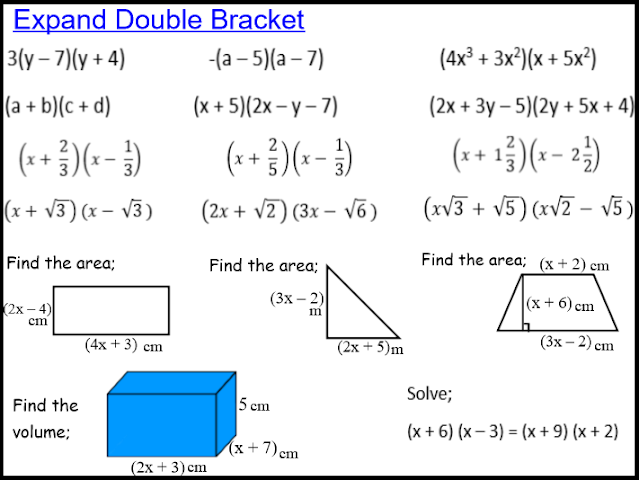
Thank you to @l88belle for sharing a task on expanding double brackets that interweaves fractions, surds, area, volume and solving equations. It's helpful to think about the ways we can make links between different topics. I look forward to seeing more from Belle on her website linkedmaths.weebly.com.

5. Resources
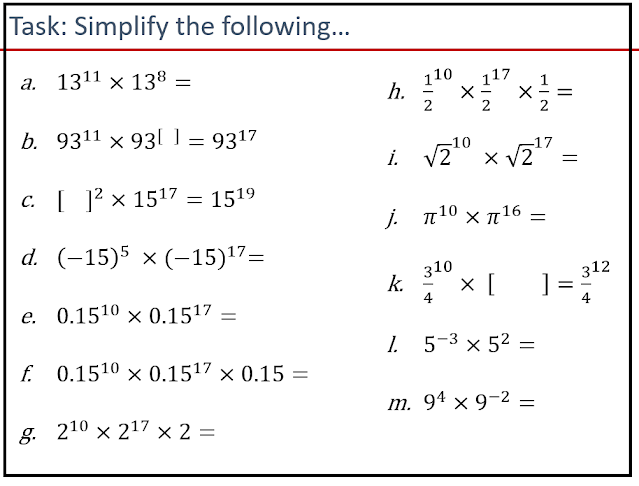
Thanks to @jshmtn for sharing a lesson on index laws with lots of good ideas to borrow. I never thought of using pi as a base!

@draustinmaths continues to add new resources to her website. Latest additions include some excellent surds tasks. 

Update
Half term has finally arrived, much to everyone's relief. My school gets a two week October half term (I know, we're very lucky) but my daughters only get one week off. So I've had a week to myself - it's the only week in the entire year that I get a little bit of 'me time' (in between dropping them off and picking them up from school), so it does wonders for my mental health. As well as taking a bit of time to chill, I also used this week to contribute to some discussions about maths education. On Monday I attended an MEI Curriculum Committee meeting, and on Tuesday I participated in a Sheffield Hallam Uni/Royal Society roundtable on textbooks and curriculum materials. On Wednesday morning I chatted to Julia Smith about methods, and in the afternoon I recorded a new Topics in Depth CPD workshop on angles in polygons for Lumen (watch this space!). On Thursday evening my husband and I went to see Harry Baker perform, which was absolutely lovely. Harry is a mathematician and poet - I must book him to come and speak at my school. 

Did you see my latest blog post? I wrote about curriculum sequencing and shared the slides from my recent conference session. 

Speaking of conferences, you only have a couple more weeks to sign up to speak at the MA Conference which is taking place between 12th and 14th April 2022. I really encourage teachers to propose a workshop, even if you've not delivered at a conference before. The MA's 2021 online conference was a huge success. The beauty of online conferences is that they are widely accessible - people who are unable to attend in-person events can easily participate. In 2022, two days of the MA Conference will take place online and the final day will take place in person in Stratford-Upon-Avon. I plan to attend both the online and in-person days. In fact, I'm delivering one of the keynotes.

Finally, I'll leave you with this tweet from @mansbridgemaths which made me laugh! It's a great task, similar to 'What's z?' from MathsPad.


If you're on half term this week, have a good one!


27 July 2021

5 Maths Gems #146

Welcome to my 146th gems post. This is where I share some of the latest news, ideas and resources for maths teachers. 

1. Pythagoras 
Teaching Pythagoras was one of the highlights of the year for me. What an awesome topic. Thank you to @giftedHKO for sharing some lovely Pythagoras tasks on her blog - I look forward to using these next year.


In case you missed it, do check out @Mr_Rowlandson's recent blog post Playing With Pythagoras and Trigonometry which features lots of clever ideas.

2. CIMT Textbooks
I've made heavy use of CIMT textbooks since my PGCE. I own physical copies but when planning lessons I usually download the CIMT resources from TES, where they are in neat bundles along with the answers. The challenge is working out which bundle to use. Though they are organised by topic, sometimes it would be helpful to be able to search through all the resources. Thankfully, @nathanday314 has come to the rescue by merging all the CIMT practice books into one searchable, fully-indexed, 2100 page PDF. Thanks Nathan!


3. Surds
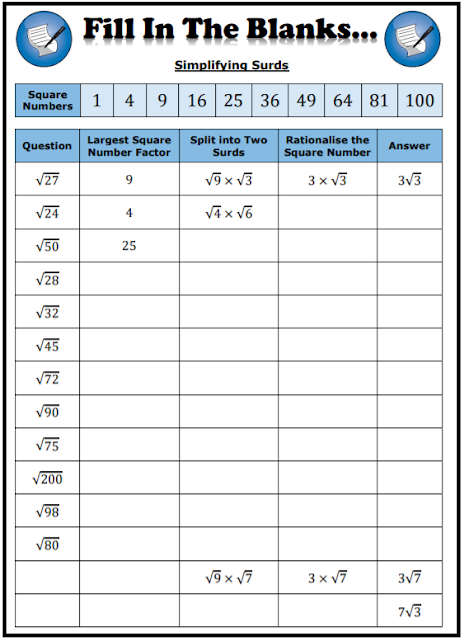
After a couple of years of only teaching Key Stage 3, my school has finally grown to the point of having GCSE classes! Hurrah. We'll be starting Year 10 with surds, and I like this introduction from @JaggersMaths.


For more ideas for teaching surds, checking out my surds in depth workshop.


4. Problems
Thank you to @SarahFarrellKS2 for sharing a PDF document of her first hundred #dailymathspuzzle questions. These are designed for Key Stage 2 students but would be suitable for many Key Stage 3 students too.


I've added this link to my problem solving page which features collections of problems and puzzles.


5. Powers and Roots
I'm always a fan of @MrDraperMaths's blog posts. His latest post focuses on powers and roots and is packed full of great tasks.


Update
Term ended on Friday for me and I now have five weeks to recover (and, sadly, catch up on the vast amount of student timetabling work I didn't get time to do before the end of term). This year was unbelievably brutal. To those of you who contacted me through Twitter or email in the summer term and didn't get a reply: I'm incredibly sorry. My role got totally out of control for a while there, and I failed to keep on top of anything outside of work. I'm hopeful that things will improve next year. 

In case you missed it, do check out Jemma Sherwood's (@jemmaths) excellent post 'Consistency and Autonomy', which follows on from some ideas I wrote about in a blog post back in May.

Also have a read of Anne Watson's latest post in the Dose of Don series. This post explores Don's thinking around angle bisection. 

If you're looking to spruce up your classroom or corridors this summer, you'll find loads to choose from on my displays page.

I can't wait to get my own classroom back. I'm sure many teachers feel the same. On the first day of the holidays I took my daughters into school (always a treat for them!) and they helped me clear out all the rubbish left in there by the various nomadic teachers who used it over the course of the year. I'm much happier now it's all sorted. I'm not fussy about pretty displays but I do like a splash of colour to brighten up a dreary room, so I used Sarah Carter's maths symbols display to cover a blank board (no backing, borders or laminating so it was a five minute job - and I'm not bothered that it's a bit wonky!). I've moved the desks away from the wall to stop students ruining it.
After an exhausting year which has left me feeling totally defeated, spending an hour preparing my classroom has cheered me up and made me look forward to September.

Nothing special, but I can't wait to get my classroom back!


Thank you to Kyle Evans for sending me a copy of his new book Maths Tricks to Blow Your Mind. My daughters are doing a swimming crash course this week and this makes perfect reading while I'm waiting for them by the pool!


I'm off on holiday with my family on Monday, and I will do my very best to switch off completely for two weeks. Have a lovely summer everyone!


15 May 2021

5 Maths Gems #144

Welcome to my 144th gems post. This is where I share some of the latest news, ideas and resources for maths teachers. 

1. Tasks
I've spotted loads of great new tasks on Twitter in the last few weeks. 

@giftedHKO shared a nice area task - perfect timing for me as I'm teaching area to Year 7 next week. This task features amongst a collection of fantastic area ideas here.

@DanielPearcy's Year 10 class were struggling to remember negative indices and so he made this homework. It's so unusual to see negative indices in these contexts.


@ticktockmaths shared a lovely bounds lesson. I am a big fan of the format and structure of his slides as well as the content.


Another resource shared by Richard was this great starter Two or a half?.

Richard also shared a task where students are asked to find coordinate pairs to fit into Venn diagrams. What a great introduction to simultaneous equations! Richard got the idea for this task from @mpershan's excellent book Teaching Math with Examples. 


2. Self-Explanation Prompts
Speaking of tasks inspired by Michael's book, @karenshancock also shared an idea that came from Teaching Math with Examples: self-explanation prompts.


Karen has shared more examples of self-explanation prompts on her Twitter feed. To quote Michael's book, "The idea is to push students towards explaining ideas they might not even have realized they don’t understand. It’s also a useful chance to ask students to dig deeper and answer some “why” questions that can connect a procedure to concepts".

3. MathsPad
For many years MathsPad has been my first port of call for resources when planning lessons, and it's getting better and better. I have blogged before about their new range of topic booklets which are a bit like textbook chapters, but with far more depth and a greater range of activities than typical textbooks. They have published booklets for six topics so far: place value (which is free), calculations, negatives, fractions, indices and introduction to algebra. Here's an example of a task from the indices booklet:

4. A Level
In response to the disruption caused by the pandemic, the AMSP (@Advanced_Maths) has been working on six Support Packages for maths teachers and students. They bring together loads of resources, PD opportunities and support. AMSP material is always top quality and I'm sure these resources will be very helpful to students and teachers in Years 10 to 13. 


Thank you to @naikermaths for sharing six Year 13 statistics practice papers on their website.


And thank you to @Miss_Jethwa for sharing ten new A-level Further Maths papers on jethwamaths.com.

5. Methods
I love these creative methods that @staceymaths' students came up with to solve equations involving fractions. Clever stuff.

Mathematics in School
I am incredibly proud to have guest edited the latest edition of ⁦the MA's journal⁩ Mathematics in School with ⁦Ed Southall. It’s a tribute to Don Steward. If you're not a member of the MA then join now and you will be sent a copy. It's packed full of excellent articles.


Update
Did you see the Gem Awards post I published in April? If not, do check it out for a huge collection of amazing resources, ideas and websites to visit.


In the Easter holidays I attended a GLT Book Club meeting to chat about a chapter from my book A Compendium of Mathematical Methods. The recording of the session is here. I was really impressed by the quality of professional development in these book club meetings. 

Did you see @Mr_Rowlandson's blog post Thinking About Probability Trees? He is one of my favourite maths bloggers and his posts are always worth a read.

Don't forget to buy a ticket for the next La Salle maths conference which takes place on 10th July. I will be speaking about how to teach for depth instead of rushing ahead.


I'll leave you with a Don Steward task. Though it may look like a typical angles exercise, it was exactly what I needed recently when I was looking for a set of questions that only involved basic angle facts but had a good level of challenge. It reminded me of what an absolute treasure trove Don's blog is.