Showing posts with label Extensions. Show all posts

17 July 2022

Year 9 Assessment Questions

Last week I blogged about our Year 8 assessments. I set out the principles we follow when we write our Key Stage 3 assessments, and I shared examples of the questions that challenged our highest attaining students. 

Today's post is about Year 9. My school's Year 9 cohort has a very wide range of maths attainment, which was further exacerbated by the lockdowns in Year 7 and 8. One notable feature of this year group is how incredibly good the high attaining students are. The top set teacher finds it hard work to sufficiently challenge them in lessons. So when I made the end of year assessment, I had to ensure there were plenty of questions in there to make them think. I don't want anyone coming out of a maths assessment bragging that they found it really easy.

Here are some of the more challenging questions from our end of Year 9 assessment.

Ratio

At a concert the ratio of men to women is 5 : 3.
The ratio of women to children is 7 : 4.
Show that more than half of the people at the concert are men.

This was a middle-of-the-paper question. It's not massively challenging - I taught set four out of five and a few of them managed to get full marks on it. But I wanted to include it here because it's a nice question requiring a bit of reasoning. It was originally from an AQA specimen GCSE paper.

A more difficult ratio question was this one from Edexcel, which also tested another Year 9 topic: changing the subject.

The ratio (y + x) : (y - x) is equivalent to k : 1.

Find a formula for y in terms of k and x.


Surface Area
Surface area is a great topic because it presents many opportunities for problem solving and reasoning. For example, this classic question may have been fairly straightforward for a high attainer, but I like the way it's also accessible to anyone who does a bit of thinking. I was delighted that a few students in my class worked this out. We put it in our non-calculator paper so it also tested their arithmetic.

The total surface area of a cube is 294cm2.
Work out the volume of the cube.


A slightly more difficult question was this one from Edexcel. It doesn't have any particularly challenging reasoning in it, but has got a multiple steps to work through, including unit conversion which might be missed. I like questions where students have to identify that they need to work with surface area rather than volume.


The most challenging surface area question I included was this one from AQA. Very few students could do this, even our highest attainers. We will revisit questions like this in Year 10.


Bounds
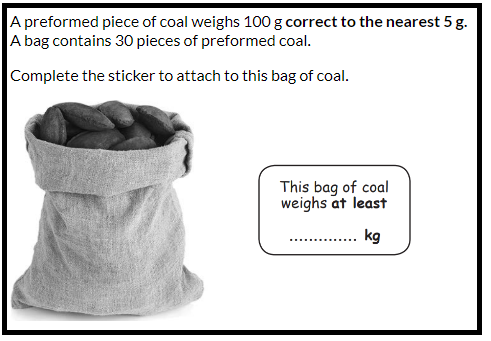
I like this coal question from WJEC. In Year 9 we teach bounds and error intervals for the first time. We introduce some basic bounds calculations, but go into greater depth on this at GCSE. This question fitted perfectly. However, I thought our students would find it easier than they did. I had it near the start of the paper, but most the students in my class only picked up one mark on it. My students are all working at a Grade 4 level though. Our higher attaining students had no problem with this one.


Probability
We taught Venn Diagrams to Year 9 this year. There were some fairly straightforward Venn diagram questions nearer the start of our end of year assessment, where students basically just had to complete various Venn Diagrams. But for challenge I wanted to test understanding of notation as well as probability, so I adapted an OCR AS level question. Only our very best mathematicians answered this correctly.


Algebraic Proportion
Algebraic proportion can be incredibly procedural. As long as students read the question carefully, once they know how to do it, it's almost a guaranteed five marks. So I included a non-calculator proportion question that was a bit different to questions they'd seen before. What I liked about this was the accessibility: no one from my class got all the marks, but they did manage to pick up one or two.


Right-Angled Trigonometry
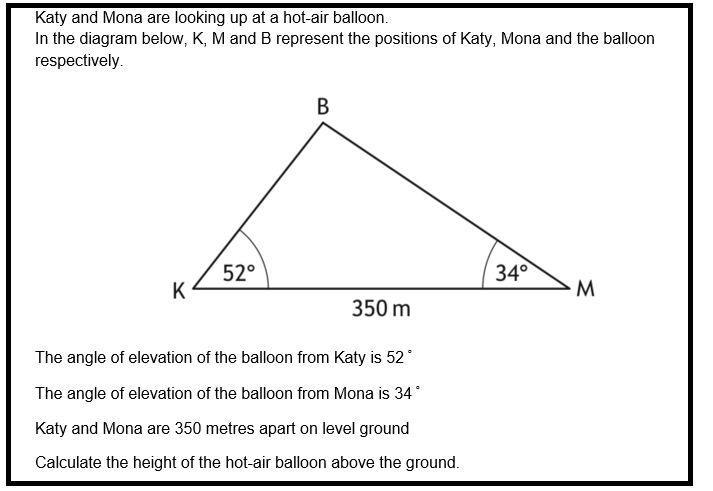
This question was my pièce de résistance. I figured that if our super clever Year 9s breezed through all the other challenging questions I threw at them, they would surely have to stop and think at this point. This SQA question is designed to be solved using the Sine Rule. But our students don't do the Sine Rule until Year 10. This question can be done with right-angled trigonometry. The way I did it was by splitting the base into x and 350 - x, then forming two equations for the height and equating them. Even if our students managed to get this far, solving the equation would be fairly challenging for them because they haven't seen anything like this before.


As it happened, none of our Year 9s managed to solve it in the way I envisaged. But one very smart student came up with a genius (albeit inefficient!) method of trial and improvement. I yelped with joy when I realised what he'd done:


It's such a delight to see students using creative approaches like this.

I also found some great challenging questions involving standard form and percentages, but I will stop at this point otherwise this blog post will go on forever! Like I said in my last post, there are numerous places we can find good assessment questions for Key Stage 3. It's a shame they aren't centrally produced anymore - the old KS3 SATs contained great questions, but at least we can still draw on those to make our own assessments.

If you have any good Year 9 assessment questions you'd like to share, please tweet me. 

Thanks for reading!


9 July 2022

Year 8 Assessment Questions

This year I produced our end of year assessments for Year 8 and 9. We have a few basic principles that we follow when we create our Key Stage 3 assessments: 

  • Single Tier Key Stage 3 Assessments. I know this one is controversial, but I want every student in the year group to take the same assessment. I've never been happy with prematurely allocating students to tiers in Key Stage 3. When we've done that in the past, I've found that students end up getting 'stuck' in certain sets. So now, although our regular end-of-topic tests are tailored to each class, our big assessments (twice a year) are one-size-fits-all. This makes the assessments more difficult to write, but helps us get a better sense of relative attainment across the whole year group.
  • Testing All Taught Content. We know it's frustrating for students to spend ages learning and revising topics that are then not tested. So we try to include questions from every topic taught during the year. And we would never test on topics not yet taught - this is counterproductive (it damages confidence and tells us nothing). This is why we don't give full higher tier GCSE papers at the end of Year 10 - I'm strongly opposed to it. 
  • Testing Knowledge, Skill and Reasoning. We want to test procedural fluency and reasoning skills, but we don't believe there's a strict separation between these things. Well-written questions test both, so we try to find as many of those as we can.
  • Challenge. It's so important to include a good level of challenge. I can't stand it when students finish a 60 minute assessment in 20 minutes and then sit there looking bored because they found it easy. There should be plenty of questions that make them think. And given that the outcomes of these assessments help us determine the groups we'll put students in next year, we need our assessments to provide us with enough information to get these decisions right. If half the year group get 90%+, it's not helping us identify our strongest mathematicians.

Question Style
I don't have time to write many of the questions myself. Thankfully there are plenty of good questions around, and tools like Dr Frost mean they are easily accessible. Here's an example of a question that is well suited to a single tier Key Stage 3 assessment:


This is from a WJEC Foundation paper. What I like about this is that Part a is very accessible to all students with a calculator. So the vast majority of students can get a mark here. Part b requires an understanding of inverse operations. Some of our lower attaining students found that more difficult than we expected them to.

Here's a similar one. I adapted this from an old AQA GCSE question. The majority of students got Part a correct. But Part b required a bit more thinking, and it surprised me that many students got it wrong, suggesting we need to work on their proportional reasoning.


Questions with multiple parts where the first part is highly accessible and the parts get increasingly difficult are perfect for single tier assessments. Ideally every paper would full of these, then you don't end up with the situation where some students can only do the first four questions and can't access the rest of the paper. Here's another example of a question that has both accessible and challenging parts:


Perhaps this ramps up in difficulty too quickly. There could be an additional part between b and c with moderate difficultly.

If a paper is full of questions like this then it's both accessible and challenging. Next year I want to include more of this. This year my paper ended up with the classic format 'easier questions at the start, harder questions at the end', which doesn't create a nice experience for the lower attaining students.

In the remainder of this post I want to share some of the more difficult questions I included in my Year 8 assessments. Some of our high attainers said they found the mid-year assessment too easy, and I didn't want a repeat of that. 

Circles
In Year 8 our students are introduced to pi, and they learn how to find the circumference and area of a circle. We go into depth by exploring questions involving semi circles and quarter circles, which takes a lot of reasoning. MathsPad has some great tasks for this:


And for even more challenge, there are problems like this:


There's absolutely no need to accelerate onto the formulaic θ/360 πrwhen there's so much reasoning to be done in Year 8 with semi circles and quarter circles.

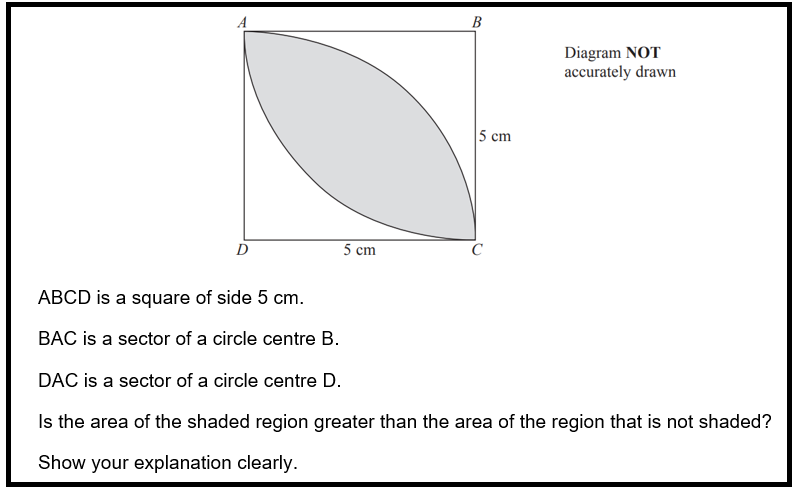
To test these reasoning skills I included this question in the non-calculator assessment (taken from OCR's sample GCSE questions):


And this question in the calculator assessment (I can't remember the source of this one - I think it might be Edexcel?):


Even our very best Year 8 mathematicians found these questions challenging. In my very bright Set 2, no student got more than one mark on either question. This suggests we still have work to do on developing their reasoning. 

Fractions
Although this wasn't one of the most challenging questions on my Year 8 assessment, I decided to give this question a mention here because it surprised me. Fractions questions are often so procedural, I wanted to include a fractions question that took a bit more thinking. Even though the vast majority of students in my class have no trouble adding, subtracting, multiplying and dividing fractions, this question was answered very badly. Even halving five eighths proved conceptually challenging. 


Volume
There are lots of 'high tariff' volume questions to choose from. These are good for a single-tier assessments because most students should be able to pick up some of the four or five marks available even if they can't complete the whole question. 

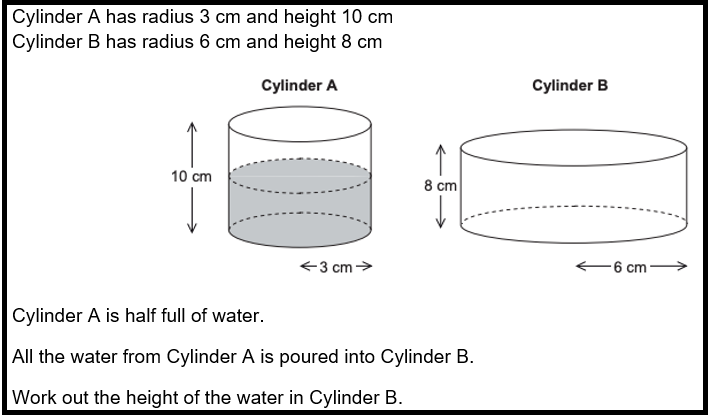
This cylinder question (adapted from AQA) stumped most of my students. They all correctly worked out the volume of water in the Cylinder A, but then found the volume of the whole of Cylinder B and divided one volume by the other. This is a classic example of students following a formulaic approach to answering a question, rather than stopping to think about what the question actually says.


Interweaving
As much as possible I tried to find questions which combined more than one topic they'd studied this year. This is particularly easy to do for Pythagoras and ratio, which both come up all over the place. For example, this question combined ratio and percentages:


Joseph’s flock has 55% more sheep than goats.

What is the ratio of goats to sheep in the flock? Leave your ratio in its simplest form.


This was originally an IMC question. Can you guess what went wrong? Most students in my class simplified 45:55 instead of simplifying 100:155 (or equivalent). They have the knowledge they need to answer this question correctly. They just didn't think.

They had much more success on this 'problem solving' style question on the non-calculator paper which also involved ratio and percentages.

Andrew is paid £250 a week.

Each week, he:

- shares his pay with his sister in the ratio 3 : 2

- saves 12% of his share.

How many weeks will it take Andrew to save £360?


This is an AQA GCSE question from 2014. It was done pretty well.

And even though we'd spent time on questions just like this back in December, not a single student in my class picked up any marks on this non-calculator question:


This is a SQA specimen question but I added the requirement to answer without indices to add extra challenge. It interweaves index laws, fractions and expanding brackets. All three topics were on our Year 8 curriculum.

Although we do a lot of work on fractional and negative indices in Year 10, we do look briefly at negative indices in Year 8. So the higher attaining students should know that x-1 = 1/x  and x0 = 1. They didn't get this far though. A few students realised that they should be adding the indices, but they seemed to panic at the thought of adding 1/2 to -3/2. Now I think about it, I remember A level students finding this kind of thing difficult when we used to teach C1 too. Perhaps this is something to spend more time on when we do fractions, instead of skipping over fractions with common denominators.

*****

I've featured a number of GCSE questions here, but I should emphasise that our Key Stage 3 assessments draw on numerous sources, including old Key Stage 2 SATs questions and old Key Stage 3 questions. Anything that's right for our students goes in, we're not precious about what it was originally written for. I wish I had more time to write my own questions.

I'd love to see some of the questions that most challenged your Key Stage 3 students in their assessments this year, so do tweet me some examples. 

I'll write a similar post soon about some of the questions I used to challenge Year 9.


*****

For context, I work at a comprehensive school in the London Borough of Sutton. There are five grammar schools in our borough, which slightly reduces our intake of high attainers. We are proudly non-selective. It's a fairly affluent area so only 14% of our students are pupil premium. We are quite ethnically diverse (41% White British compared to 66% nationally). We have 22 students with EHCPs. We are a new school with around 200 students per year group and we currently only have Years 7 - 10 (we'll have Year 11 next year). In general, most of our students have excellent attitudes to learning and want to do well. The average score on our end of Year 8 assessment was 57% and the highest score was 95%.



10 June 2018

5 Maths Gems #90

Welcome to my 90th gems post. This is where I share some of the latest news, ideas and resources for maths teachers.

1. Probability Task
Thanks to John Rowe (@MrJohnRowe) for sharing this challenging probability puzzle. If you like this then you'll find similar tasks for a wide range of topics on the fantastic website openmiddle.com which I've blogged about before.

2. Exam Wrapper
Thanks to Alice Leung (@aliceleung) for sharing an exam wrapper for students to complete after an assessment. I like it that students are asked to reflect on whether they did sufficient preparation for the exam.
 3. Number Properties Puzzle
Here's a great number puzzle from @OCR_Maths.
4. A Level
If your Year 12s have internal exams coming up, you might find my revision quizzes for pure and statistics helpful. I've told my students to print off a load of these and test themselves at home until they get everything right. The statistics quiz has a huge number of definitions! 
There was a helpful discussion about A level taster lessons on Twitter this week, initiated by Adam Creen (@adamcreen). You can read the full thread here. I have found in the past that Pascal and Binomial works well. I've also used Susan Wall's lovely 'Find the coordinates' task successfully as a starter activity in A level taster lessons.
5. Euclid
Thanks to @MrsMathematica for sharing this video about Euclid - I enjoyed watching this.


Also check out The History of Non-Euclidian Geometry - Squaring the Circle and The History of Non-Euclidian Geometry - The Great Quest.

Update
In case you missed it, I recently wrote a subject knowledge post about algebraic highest common factor and lowest common multiple. Writing this made me rethink my approach to teaching this topic. 

I also published three sets of breakfast warm up resources for both Higher and Foundation GCSE. It's been lovely to see so many schools using these to calm nerves and warm up brains on the morning of exams.

I also published a set of Year 3 topics in depth packs created by Nikki Martin - please share these with primary colleagues.

There have been a number of good maths education blog posts lately that are worth reading, including:

I'm looking forward to presenting at #mathsconf15 in Manchester in two weeks - my workshop is not just an opportunity to share loads of cool indices stuff, but also to explain the principle of planning and teaching topics in depth. In a world of quick fixes, I'm going in the opposite direction... I wrote a post about this last year.

If you're coming to the conference, print a copy of my #mathsconf15 bingo in advance and play along on the day.

Finally, did you see these awesome biscuits made by Ella Dickson (@elladickson) for her Year 13 students? Amazing!


27 August 2016

5 Maths Gems #62

Welcome to my 62nd update from the world of Maths EduTwitter. Here I summarise some of the latest ideas and resources for teaching maths.

1. A Brilliant Problem
If you have a Facebook account then it's definitely worth liking Brilliant.org's Facebook page for an ongoing flow of lovely maths problems in your news feed. I particularly like the problem below - I'd use it as a starter in a GCSE lesson.

2. Symbaloo
Emma Bell (@EJMaths) has created a very helpful Symbaloo of maths education websites. All you have to do is click on 'start using this webmix' and register for a free account. You can make it your homepage so whenever you open the internet you'll have a lovely set of maths websites, blogs, tools and resources to choose from. This will save teachers lots of time and help them discover new websites too.

3. Fraction Division
An approach to dividing fractions that doesn't involving 'flipping'... this method from @solvemymaths is worth a look.
4. Indices
@offpistemaths shared these indices questions from an Eton scholarship paper aimed at Year 8. I love these problems - more of our students should be given the opportunity to try challenging questions like this.
5. Interactive GCSE Questions
Here's a new free resource from MathsPad. These interactive GCSE exam-style questions are available for both Higher and Foundation. They would work well as daily lesson starters on an interactive whiteboard. It's easy to switch questions and display answers.

Update
Summer is nearly over! A level and GCSE results days were particularly emotional and exciting for me this year (my first results at my new school). It's weird to think that this was our last GCSE results day with grades A* to U - next year we'll be seeing numerical grades for the first time. It's also weird to think that the coming school year will be the last time we teach C1 and C2, as modular A level comes to an end.

You might be interested in seeing the 'hardest' question on this year's Edexcel maths Higher GCSE, which was only answered correctly by 2.6% of students (thanks to @MathsEmporium for sharing this).
Earlier this week I went along for drinks at La Salle's #pieandmaths event - it was great to catch up with some Twitter friends and meet some new people. I'm really looking forward to #mathsconf8 in Kettering on 1st October (I've now submitted a workshop proposal) - book now!

Posts
Did you catch my recent post about Multiplying Negatives? If you're teaching addition and subtraction with negative numbers, you might like this post from @Ed_Realist.

I enjoyed reading these recent blog posts:


As the start of term approaches, you might find these 'back to school' posts helpful:


Twitter...?
If you're not on Twitter then the start of the new school year might be a good time to join... The amount you gain from it is well worth the small investment of time. Email me for advice if you're not sure how to get started!
A Problem
I'll leave you with this lovely set of problems shared by @Mathematical_A, taken from 'A Square Peg in a Round Hole'. Find the fraction of the area of the quadrant occupied by each semicircle.


18 August 2015

5 Maths Gems #37

Hello and welcome to my 37th gems post. This is where I share some of the best maths teaching ideas I've seen on Twitter. If you enjoy reading these posts then you might like to explore my new hashtag #mathsgems to see highlights from previous posts.

Last week I attended #pieandmaths - this was an event organised by La Salle Education in which a group of maths teachers got together to discuss issues in maths education. It was a great day and I've included a short write-up at the end of this post.

I have a surplus of gems this week so here's the first five, with five more to follow later this week.

1. Brilliant Indices Question
I first wrote about Brilliant.org in Gems 21. I 'like' Brilliant's Facebook page which means I get regular maths problems in my Facebook feed. Since I joined Twitter I haven't used Facebook much, but I've been on there quite a bit this week working on my new Facebook page. Luckily that means that I spotted this awesome question from Brilliant:
My Year 12s will be treated to this in September! 

2. 1001 Math Problems
Thanks to Denise Gaskins (@letsplaymath) for sharing the website 1001 Math Problems. This American website was created as a source of problem-solving activities for elementary and middle school children. The problems are accessible and engaging. Solutions are included.

Here's a lovely example, taken from the selection of puzzles that explore factors/divisibility:
The problems are mainly suitable for Key Stage 2 and 3. I love 'The Spilled Juice Problem'.

3. Simulations
Last August I wrote a post Animations and Simulations, and since then I've occasionally featured animations in my gems posts, like this lovely demonstration of the area of a circle from Gems 12.
One of my favourite simulation websites is PhET Interactive Simulations which I'm told is particularly useful for teaching Mechanics at A level. Some of the simulations on PhET are suitable for Key Stage 3 and 4, such as this estimation activity. Do have a play with this activity, it's great.
Thanks to a tweet from @ChristinaGawlik I've also discovered the recently revamped website www.explorelearning.com. This is the 'world's largest library of math and science simulations'. These simulations (called Gizmos) are really good. Unfortunately unless you pay a subscription, you can only access each Gizmo for 5 minutes. Worth a look though.

4. VideoScribe
Chris Smith (@aap03102) shared an impressive promotional video for his newsletters. He said it only took him 15 minutes to make this video and I didn't believe him! I set up a trial of VideoScribe and found out he was right - it's very quick to make a video using this software. Here's my attempt - a fun (but pointless!) promo video for resourceaholic.com:


I was wondering if there were any opportunities to use this software in the classroom when I coincidentally stumbled across this Classroom Expectations video from Cathy Yenca (@mathycathy):


Since starting at a new school and having to do 'proper' behaviour management for the first time, I've realised the importance of setting expectations for students. I think this approach might make those expectations more memorable (and even if it doesn't, it's fun to make the video!). Cathy says, "I plan to show this brief video I created using a free 7-day trial of VideoScribe and give students a hard copy of classroom expectations to fill in a few blanks as they watch. I may show this several times during the first few weeks of school, post it on my website, and generate a QR code to link to it when someone needs a reminder".

I spotted Cathy's video in her excellent post First Days Favorites which lists some lovely activities for first lessons. It's well worth a read.

5. Challenges
I get email updates from Steve Lyon (@SteveJLyon) of National STEM Centre. Through this I spotted these Mathematical Education on Merseyside Challenges. Mathematical Education on Merseyside (MEM) is an organisation providing enrichment activities such as masterclasses and challenges. The challenges, which date back to 1980, were originally presented as take-home competitions for use during February half-terms. These are really nice sets of questions which could be used for competitions or lunchtime maths clubs, or perhaps for stretch and challenge in lessons.

This question is taken from the 2005 Senior Challenge (aimed at Year 9 and 10):

HOPPING MAD 
Starting at A, a fixed point on a circle with centre O, I move anticlockwise one quarter of the way round the circle to a point W, then hop across to X, the opposite end of the diameter through W, then travel one fifth of the way round the circle clockwise to the point Y, before hopping across to Z, the point at the opposite end of the diameter through Y. How big is the angle <AOZ?

And these questions are from the 2006 Challenge (aimed at Year 7 and 8):

Recommended Reads
If you teach maths at Key Stage 3 then I strongly recommend that you read Michael Tidd's (@MichaelT1979) post "10 things you might not have realised about the new Primary Maths curriculum".

Thanks also to Colleen Young (@ColleenYoung) for her post about World Maths Day. It's on 14th October 2015 and now open for pre-registration.

I've made quite a few updates to my website this week. In response to lots of queries about primary school maths resources, I added a Primary Maths page which links to blogs and resources. I updated my Conferences page, my New GCSE page and my About Me page. I also wrote a post about tangents and areas based on the new GCSE specification.

Pie and Maths
La Salle Education is a company dedicated to improving mathematics education. I love La Salle's conferences and will be presenting at their next conference in Sheffield in September. Last week La Salle hosted an event called Pie and Maths which was attended by some of my Twitter buddies, so it was a good chance to catch up with people and talk about maths.

The event started with a demonstration of Complete Mathematics. This is a really impressive system and if you've not seen it before then it's worth exploring - La Salle can come to your school to demonstrate it. I really support the underlying principles of Complete Mathematics - it has the potential to be the ultimate collaboration tool for maths teachers. The content and functionality have developed well since I first saw it last summer. The interface is really user-friendly, allowing teachers to efficiently plan lessons with access to well-written objectives, pedagogical notes, resources and assessment tools. Complete Mathematics currently covers Key Stage 1 through to GCSE. New content is being developed for Core Maths, providing much needed structure and resources for this new post-16 qualification.
Can you name the Twitter handles?
We enjoyed a lovely lunch and then went to the pub for a debate, led by Mark McCourt (@EmathsUK). We discussed a number of issues including behaviour, parenting, teaching methods, teacher training and research.

Afterwards we had lots of time to chat and play maths games - I ended up tied to Bruno Reddy (@MrReddyMaths). This video shows how we got out of it (well done Bruno, I had no idea!).
Thanks to La Salle and Mark McCourt for organising a really enjoyable event. I loved catching up with Twitter friends and meeting new people - here's the list of attendees (sorry if I've missed anyone!): @getdiagnostics, @nishadealwis, @mrdrapermaths, @naveenfrizvi, @MissBsResources, @MissBaileyMaths, @kris_boulton, @DrTrapezio, @craigos87, @EJmaths, @tessmaths, @ColinTheTrainer, @MrMattock, @dannytybrown, @RJS2212, @mrreddymaths, @mathsatschool, @MrBenWard, @xanbritt, @CubbonSue and @mathsjem.

That's it for today's post. Good luck with GCSE results everyone! I'll leave you with this cute Nonagon video shared by @solvemymaths.

9 November 2014

5 Maths Gems #13

In my gems posts I share some of the best teaching ideas I've seen on Twitter each week. This is my 13th gems post. I hope you're not triskaidekaphobic.

1. Flying Numbers
At Julia Smith's (@tessmaths) creativity workshop at the last maths conference, she shared an activity in which students make 'Flying Numbers' to hang from the ceiling in the classroom or corridor. It works like this: they choose a number and make that number from wood in Design & Technology (drill a hole at the top for hanging). They paint their number then use fine markers or chalk pens to decorate it with facts about that number. This is a lovely opportunity for students to use the internet to explore number properties and find out all sorts of wonderful mathematical things that are not on the curriculum. The examples below were made at the maths conference - it was a really enjoyable exercise.
Ed Southall (@solvemymaths) suggests using numbergossip.com and numdic.com for researching number properties. Of course it's important that students understand the properties they choose - do they know the meaning of all the words they use to describe their number? Prime, square, perfect, palindromic, narcissistic, repdigit... And do they know about different number systems? For example, you could make a whole lesson out of binary (see my earlier post about teaching a binary lesson).

Ed also created some brilliant 1 - 9 number posters this week - your students could create posters like this as an alternative to the 'flying numbers' activity.

Here's a related idea - Number Experts. When you get your new Year 7 class next year, assign a number to each student and tell them that during the year they will become an 'expert' in that number. For example student number 25 would accumulate interesting facts about the number 25 throughout the year, sometimes making connections to the topics they cover in maths lessons, and at the end of the year they could produce a display piece about that number. Your class could even present their number facts in a school assembly. In this enriching exercise students are given a rare opportunity to step into the amazing world of numbers and perhaps it will give them a greater appreciation for the beauty of mathematics.
Source: The Value of Teaching Mathematics, Philipp Legner, Mathigon
2. Mathigon
Speaking of beautiful mathematics, the Mathigon website is amazing! Parts of it are still under development but new stuff is added all the time - the quality is superb. The website says, "Mathigon wants to improve the public understanding of Mathematics, why it is exciting and why it is important. And there is no better place to do that than in schools! Teachers are encouraged to use the resources on this site to enrich the mathematics curriculum and show children how fun and beautiful mathematics can be". Inspiring stuff. Check out the website for yourself (the ebook is excellent!) - here's a few features to get you started:
  • Alice in FractalLand is a stunning animated slideshow. Show it to your class and explore sequences, fractals, the golden ratio and more. The text at the bottom explains each concept very clearly. I love this! This is exactly the sort of thing I was referring to in my post 'A place for gimmicks?' when I said that we should make time to enrich our students' education with interesting mathematics that is not on the GCSE syllabus.
  • The Primary and Secondary Treasure Hunts are very well designed. Full instructions are included and there are questions on areas of mathematics such as cryptography, primes and probability. The questions are rather challenging for the intended age groups - if I was organising an inter-school maths contest then I might use these questions.
  • The video collection is due to grow - an exciting prospect if this two minute wordless video exploring triangles is a taste of things to come. 

3. Imbalance Problems
If you're not familiar with Don Steward's resources then stop reading this post immediately and check out his Median blog. Mr Steward posts new resources all the time - his last few posts have had a 'balancing' theme. First there was this post 'mobiles', then 'mobile inequalities' and finally 'mobile moments'.

In mobiles, the activities start with number problems that get progressively harder, then move on to algebraic balancing problems. Here's a numerical example which can be solved with arithmetic and logic (fill in the missing weights so that everything balances correctly). 
There are lots of variations, such as this one where the weights must add up to the number in the triangle (this is a straightforward example):
The algebraic problems develop skills in writing algebraically and simplifying expressions. In the problem below, students have to complete the missing weights to make the combined hanging weight equal to 8n.
These are great problems. Check out all three posts to see how Mr Steward developed the idea. It's also worth reading Paul Salomon's (@lostinrecursion) post 'More Imbalance Problems' about students creating their own imbalance problems. Thanks to John Golden (@mathhombre) for sharing this link.

4. Desmos Water Line Activity
I've long been a fan of Desmos for graphing but I've never looked at Desmos activities before. My first introduction to a Desmos activity came from reading Jon Orr's (@MrOrr_geek) post 'Describing Relationships – Active Learning'. In a lesson on what we call 'real-life' graphs in the UK, he starts by showing this video which is low quality but still worth showing.


He then uses the Desmos Water Line activity. It only takes a few seconds to register on this site and then you're ready to go - your students login to Desmos using a four-digit code, they enter their name then complete the activities. They're shown various glasses being filled with water and they have to draw the associated graph. Their answer is then illustrated so they can check its accuracy. This website really is superb and very user-friendly - you must spend a few minutes checking it out so you see what I mean. At the end of the lesson students can create their own glasses and challenge their classmates to graph them. The teacher can see what the students are doing behind the scenes, without any complicated registration process or uploading of student data.
I'm really impressed by this technology and keen to explore Desmos' other activities. The people behind Desmos are experts at creating user-friendly interfaces.

5. Three Apps
I was going to include my thoughts on the value of iPads in mathematics education today, but I've decided that there's too much to say so it deserves its own post - watch out for one in the near future. However, thanks to @Corbettmaths, I've discovered three iPad apps that are worth a mention today. These free apps would be useful in the classroom if your students have access to iPads, but they work well on iPhones too and are utterly addictive for teachers!

First, Angles? - Let's solve figures problems! by Gakko Net Inc. In this app you have to find the marked angles in problems ranging from simple triangles to parallel lines to circle theorems. It's a very simple app that lets you write workings on the screen and enter your answer - if you're correct you move onto the next question. Hints are available. Crucially, it's not necessary to progress through all the questions in a level to move onto the next level so you can jump straight to circle theorems if you want.

The same app developer also brings us Areas? which is equally well designed. Shapes are shown on a grid and you simply have to work out the areas. Again, they start off easy and become quite challenging. For example I enjoyed this question:
You can't tell what the radius is, but you can see it's between 5.5 and 6 units. The key is to realise that the answer only contains integers.

Finally, the same developer brings us Make 10 which is an order of operations game. In each question your task is to make 10 using all four numbers.
Three excellent apps - great fun for both students and teachers.

What I've been up to
My Pret homework collection continues to grow thanks to contributions from twenty helpful maths teachers. New contributors are always welcome! I'm pleased that one of my Pret homeworks featured as Craig Barton's Resource of the Week this week - Kathryn Forster (@DIRT_expert) should be very proud of her creation. If you've not used a Pret homework before then Craig Barton's video guide is worth watching. It's great to hear that the template has been adopted by Science and English teachers too. Marsha Smith (@marshasmith244) had the great idea of giving her students blank templates to create their own Pret homeworks - having created a number of them myself, I've found that creating a Pret homework does help you think about a topic in depth.
Students' Pret homework creations from @marshasmith244
This week I've been busy reading and commenting on interesting blogs - this post about the new GCSEs from Cav (@srcav) is very helpful, especially for Heads of Department who need to start thinking about which exam board they will use from next September. Do have a look at this post from Bruno Reddy (@MrReddyMaths) too - it describes the important work he's doing to transform negative mathematical attitudes.

I'm really pleased to see that the 'hashtag marking' I suggested in last week's gems post has paid off - both Debbie Hart ‏(@Debbie_Hart_UK) and Jane Appleton (‏@JaneAppleton24) have tried it.

I've been busy writing a post about circle theorems which will be ready soon. Also, after seeing some great Halloween and Guy Fawkes maths resources, I've started to collate a 'seasonal resources' page. I've seen so many good Christmas resources, it's hard to choose the best but I'm getting there.

So there you go, my 13th gems post. It wasn't scary at all.

Image source: guernseydonkey.com