Showing posts with label Estimation. Show all posts

18 August 2015

5 Maths Gems #37

Hello and welcome to my 37th gems post. This is where I share some of the best maths teaching ideas I've seen on Twitter. If you enjoy reading these posts then you might like to explore my new hashtag #mathsgems to see highlights from previous posts.

Last week I attended #pieandmaths - this was an event organised by La Salle Education in which a group of maths teachers got together to discuss issues in maths education. It was a great day and I've included a short write-up at the end of this post.

I have a surplus of gems this week so here's the first five, with five more to follow later this week.

1. Brilliant Indices Question
I first wrote about Brilliant.org in Gems 21. I 'like' Brilliant's Facebook page which means I get regular maths problems in my Facebook feed. Since I joined Twitter I haven't used Facebook much, but I've been on there quite a bit this week working on my new Facebook page. Luckily that means that I spotted this awesome question from Brilliant:
My Year 12s will be treated to this in September! 

2. 1001 Math Problems
Thanks to Denise Gaskins (@letsplaymath) for sharing the website 1001 Math Problems. This American website was created as a source of problem-solving activities for elementary and middle school children. The problems are accessible and engaging. Solutions are included.

Here's a lovely example, taken from the selection of puzzles that explore factors/divisibility:
The problems are mainly suitable for Key Stage 2 and 3. I love 'The Spilled Juice Problem'.

3. Simulations
Last August I wrote a post Animations and Simulations, and since then I've occasionally featured animations in my gems posts, like this lovely demonstration of the area of a circle from Gems 12.
One of my favourite simulation websites is PhET Interactive Simulations which I'm told is particularly useful for teaching Mechanics at A level. Some of the simulations on PhET are suitable for Key Stage 3 and 4, such as this estimation activity. Do have a play with this activity, it's great.
Thanks to a tweet from @ChristinaGawlik I've also discovered the recently revamped website www.explorelearning.com. This is the 'world's largest library of math and science simulations'. These simulations (called Gizmos) are really good. Unfortunately unless you pay a subscription, you can only access each Gizmo for 5 minutes. Worth a look though.

4. VideoScribe
Chris Smith (@aap03102) shared an impressive promotional video for his newsletters. He said it only took him 15 minutes to make this video and I didn't believe him! I set up a trial of VideoScribe and found out he was right - it's very quick to make a video using this software. Here's my attempt - a fun (but pointless!) promo video for resourceaholic.com:


I was wondering if there were any opportunities to use this software in the classroom when I coincidentally stumbled across this Classroom Expectations video from Cathy Yenca (@mathycathy):


Since starting at a new school and having to do 'proper' behaviour management for the first time, I've realised the importance of setting expectations for students. I think this approach might make those expectations more memorable (and even if it doesn't, it's fun to make the video!). Cathy says, "I plan to show this brief video I created using a free 7-day trial of VideoScribe and give students a hard copy of classroom expectations to fill in a few blanks as they watch. I may show this several times during the first few weeks of school, post it on my website, and generate a QR code to link to it when someone needs a reminder".

I spotted Cathy's video in her excellent post First Days Favorites which lists some lovely activities for first lessons. It's well worth a read.

5. Challenges
I get email updates from Steve Lyon (@SteveJLyon) of National STEM Centre. Through this I spotted these Mathematical Education on Merseyside Challenges. Mathematical Education on Merseyside (MEM) is an organisation providing enrichment activities such as masterclasses and challenges. The challenges, which date back to 1980, were originally presented as take-home competitions for use during February half-terms. These are really nice sets of questions which could be used for competitions or lunchtime maths clubs, or perhaps for stretch and challenge in lessons.

This question is taken from the 2005 Senior Challenge (aimed at Year 9 and 10):

HOPPING MAD 
Starting at A, a fixed point on a circle with centre O, I move anticlockwise one quarter of the way round the circle to a point W, then hop across to X, the opposite end of the diameter through W, then travel one fifth of the way round the circle clockwise to the point Y, before hopping across to Z, the point at the opposite end of the diameter through Y. How big is the angle <AOZ?

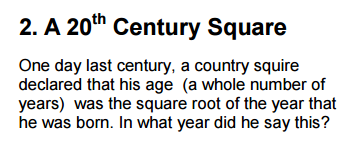
And these questions are from the 2006 Challenge (aimed at Year 7 and 8):

Recommended Reads
If you teach maths at Key Stage 3 then I strongly recommend that you read Michael Tidd's (@MichaelT1979) post "10 things you might not have realised about the new Primary Maths curriculum".

Thanks also to Colleen Young (@ColleenYoung) for her post about World Maths Day. It's on 14th October 2015 and now open for pre-registration.

I've made quite a few updates to my website this week. In response to lots of queries about primary school maths resources, I added a Primary Maths page which links to blogs and resources. I updated my Conferences page, my New GCSE page and my About Me page. I also wrote a post about tangents and areas based on the new GCSE specification.

Pie and Maths
La Salle Education is a company dedicated to improving mathematics education. I love La Salle's conferences and will be presenting at their next conference in Sheffield in September. Last week La Salle hosted an event called Pie and Maths which was attended by some of my Twitter buddies, so it was a good chance to catch up with people and talk about maths.

The event started with a demonstration of Complete Mathematics. This is a really impressive system and if you've not seen it before then it's worth exploring - La Salle can come to your school to demonstrate it. I really support the underlying principles of Complete Mathematics - it has the potential to be the ultimate collaboration tool for maths teachers. The content and functionality have developed well since I first saw it last summer. The interface is really user-friendly, allowing teachers to efficiently plan lessons with access to well-written objectives, pedagogical notes, resources and assessment tools. Complete Mathematics currently covers Key Stage 1 through to GCSE. New content is being developed for Core Maths, providing much needed structure and resources for this new post-16 qualification.
Can you name the Twitter handles?
We enjoyed a lovely lunch and then went to the pub for a debate, led by Mark McCourt (@EmathsUK). We discussed a number of issues including behaviour, parenting, teaching methods, teacher training and research.

Afterwards we had lots of time to chat and play maths games - I ended up tied to Bruno Reddy (@MrReddyMaths). This video shows how we got out of it (well done Bruno, I had no idea!).
Thanks to La Salle and Mark McCourt for organising a really enjoyable event. I loved catching up with Twitter friends and meeting new people - here's the list of attendees (sorry if I've missed anyone!): @getdiagnostics, @nishadealwis, @mrdrapermaths, @naveenfrizvi, @MissBsResources, @MissBaileyMaths, @kris_boulton, @DrTrapezio, @craigos87, @EJmaths, @tessmaths, @ColinTheTrainer, @MrMattock, @dannytybrown, @RJS2212, @mrreddymaths, @mathsatschool, @MrBenWard, @xanbritt, @CubbonSue and @mathsjem.

That's it for today's post. Good luck with GCSE results everyone! I'll leave you with this cute Nonagon video shared by @solvemymaths.

28 December 2014

5 Maths Gems #20

Hello. I'm pleased to present my 20th gems post today - a milestone! Twitter has been quiet this week because Christmas took our minds off work for a couple of days, but I've still got some great ideas for you. The Christmas holidays are short and busy so it won't be long before you're back to planning lessons - I hope this post gives you some inspiration for the Spring term.

1. Factorising Quadratics
You know Don Steward's blog is the best thing since sliced bread, right? His catalogue of fantastic rich tasks is updated all the time. I really liked his recent posts on product puzzles. He started with a set of questions like this:
In Question 1 above, you can see that the top left cell has to contain a 3 because it's a factor of both 3 and 6. The rest of the cells can be completed quickly once one common factor has been established. This is a simple example but Don develops the questions to become increasingly difficult, some having multiple solutions. 

The next set of activities extend the same idea to algebra, starting with this:
There's lots of these to complete - excellent practice of factorising linear expressions.

The next stage of this exercise is factorising quadratics.
Conveniently I'm currently planning a Year 10 lesson on factorising quadratics. I want my students to do a lot of practice so will definitely be using this activity. The questions build up to a suitably challenging level of difficulty, ending with this one:
I want to encourage my students to factorise 'harder' quadratics (ie a > 1) by inspection. This is my preferred method (ie 'guess and test') but my students always demand that I teach them a more structured approach (eg 'the Grouping Method') which frustrates me. Their insistence on following an algorithm suggests a lack of confidence. I think the question above turns factorising quadratics into a kind of logic problem. Tackling this question without an algorithm might help my students develop the confidence to factorise harder quadratics by inspection.

One last idea for a lesson on factorising quadratics - I like the problem below from openmiddle.com. There are a number of possible solutions so you could challenge students to find a different solution to the person next to them. 

2. Angle Sense with the Interactive Whiteboard
I've been planning a Year 7 lesson on angles in which I'd like my students to estimate angle sizes. If you were asked to to draw an angle of 210o freehand, how would you do it? I'd think of it as a straight line plus a third of a right-angle. If you have proportional reasoning skills then it's pretty easy to make an educated guess. An angle estimation activity would work perfectly well without technology (read out a series of angle sizes and ask your students to draw their freehand estimates on paper. They then check their estimates using a protractor - another useful skill). But if you want a similar activity for the interactive whiteboard then you might like this fun Estimating Angles Game from Nrich.
Another interactive whiteboard tool is 'How Far Does it Turn?' from MathsPad. This time your students have to estimate the size of the angle drawn - they could do this on mini-whiteboards so everyone is included in the activity.

While looking at these games, I stumbled across a big range of angle tools for the interactive whiteboard here. Some of these angle games are quite funny - Banana Hunt in particular made me chuckle.
If you like these interactive whiteboard games then you'll find loads at Sheppard Software. It's amusing that there's an Absolute Value Number Balls game - this concept isn't covered until Year 13 in the UK but I bet my students would love to play this game - five minutes light relief in a C3 lesson!
FlashMaths.co.uk is another great website for interactive whiteboard activities. Flash Maths was created by Jonathan Hall (@studymaths) who brings us a plethora of fantastic tools on StudyMaths.co.uk. If you haven't seen it before, check out MathsBot.com which is his simple (but brilliant) worksheet generator.

3. Big Questions
Billy Adamson (@Billyads_47) shared a fantastic set of mathematical thinking prompts 'The Big Questions'. Here's a few examples: 


Lovely open questions from Billy to generate discussion and develop understanding. There's some more good examples of open questions here:


4. Trigonometric Problem Solving
Our Year 13s' problem solving skills are tested when they're asked to simplify expressions involving trigonometric identities in C3 (like the example below).
I find that my students get frustrated when they can't spot a 'way in' straight away. They give up quickly. There's actually a pretty standard set of starting points, as described on www.intmath.com (@intmath). 

I struggle to help my students feel confident in tackling these problems, so I really like this activity from @mjfenton. Here's an extract:
The idea is that we start with a lot of structure and gradually give fewer hints until students are able to solve the problems themselves. The steps might seem logical to us, but we're experienced problem solvers. 

It's a good idea for maths teachers to try to solve unfamiliar problems every now and then (like the example below from ‏@dannytybrown) to remind ourselves that mathematical problem solving often requires patience, creativity and multiple attempts. We all experience frustration in problem solving, just like our students do, but we know that the satisfaction of eventually finding the solution is well worth it.

5. Dividing with Decimals
I've mentioned before that I love MathsPad's resources - plenty of them are free and the rest come at a cost of only £3 per month. Whether your school subscribes or not, it's worth registering for email updates in order to keep track of all the new resources. This month, the interactive resources on Decimal Calculations caught my eye. It always surprises me how many students will happily say that 40 divided by ½ equals 20. Activities like the one shown below will help tackle this misconception and encourage students to think before they answer.

That's it for this week. I'll leave you with a video from 1977 - 'Congruent Triangles' by Bruce and Katharine Cornwell (another gem found on @MathMunch). Happy New Year!

20 September 2014

5 Maths Gems #7

When I write these weekly gems posts I have to stop myself from going on and on about all the brilliant blog posts I've been reading. Each week I read quite a few blogs about maths teaching and wider issues in education (often via tweets from The Echo Chamber). These blogs prompt me to reflect on the way I do things and make changes to my teaching practice. Two examples this week were posts from @ImSporticus, a PE teacher who shares words of wisdom from experienced colleagues in 'Common practice of successful departments' and 'What I learnt today' - both are well worth a read, particularly for teachers of A level maths.

A lot of the inspiration behind today's maths gems has come from teachers' blogs - I'm incredibly grateful to those who take the time to share their ideas and experiences for the benefit of others.

1. Interactive Areas
Computer-based tools have made it easier to explain some mathematical concepts and generate interesting questions. It's fantastic when technology enhances and enriches mathematics education.
I recently tweeted this colourful illustration which shows that we can cut a circle into sectors and rearrange them to determine the area (taken from @edfromo's Google+ post). @fmaths42 replied with this brilliant applet which illustrates the same thing in very clear interactive steps. Never before have I seen the formula for the area of a circle explained so clearly (and did you see the 'proof without words' video in Maths Gems 4? That was good too).

Another excellent interactive tool is 'Investigating Triangle Area' (via @mathslinks). My students are always happy to accept that a right angled triangle is half a rectangle, but are not so easily convinced for non-right angled triangles. The tool illustrates the fact by allowing students to rearrange triangles into rectangles (click on subdivide and then rotate and translate the top sections).

2. Estimation
Examples from estimation180.com
I've seen a lot of American teachers tweet about Estimation 180. This is a great website created by Andrew Stadel - each day of the school year he presents his students with an estimation challenge. The aim is to help students improve both their number sense and problem solving skills. The website contains a huge range of themed estimation activities including heights, weights, distances and lengths of songs. A template worksheet is included to encourage a methodical approach to estimation. Answers are provided so students can calculate their percentage error.
Extract from Estimation180 worksheet


Another estimation resource from our friends across the pond is Fry's Bank by the legendary Dan Meyer (thanks to @katebook for sharing this). This is one of his three-act tasks. Students are shown a clip from Futurama in which Fry checks his bank balance. His 93c balance has accumulated interest over 1,000 years and students estimate (and then calculate) the account balance.

If you're going to use this activity, it's worth reading Mr Meyer's description of how he intends his three-act tasks to be used.

3. Negatives 
This week there were lots of tweets and posts about negative numbers. The first post I read was 'Why?' from @JemmaPDuck. This lovely post is about the progress her students have made in articulating their reasoning. I noticed that her students had been taught negative numbers in a way that I've not seen before. To answer the question 5 - -4, a student said "subtracting -4 from 5 is like taking 4 colds out from something which will make it warmer so 5 gets bigger by 4″. I like the temperature analogy and by the sound of it, so do the students.

We should avoid simply telling students that two negatives make a positive because it can cause confusion (see 'Damaging short cuts' by @srcav). Here's some more alternatives:
MathedUp.co.uk
  • @cpip1601 shared a really interesting method which involves using the numbers 1 and -1 to physically show why subtracting a negative works. 

If you're looking for a new way to teach negative numbers then you'd benefit from reading @MrReddyMaths's post 'How we teach addition & subtraction of negative numbers' and James Tanton's take on Negative Number Arithmetic.

Piles and holes by James Tanton

4. Cheat Sheets
Another gem from @JemmaPDuck's blog - this one is about review activities. To quote her directly: 'Occasionally I will finish a topic and give pupils time to create a cheat sheet which would be helpful if sitting an assessment on the topic. Twist is that I then give them a wee test/quiz and give them someone else’s cheat sheet. They then give feedback on how helpful, clear, understandable and useful the cheat sheet was. Good activity for clarifying thoughts on a whole unit as well'.

What a good revision idea - not only do they revise when making their own cheat sheet, they also get to try out someone else's cheat sheet - this will help all students make better revision notes in the future. A great idea. Related to this is the post 'How tests teach and motivate' from @Kris_Boulton's blog. I like the idea of regular low-stakes open-book quizzes to test the application of knowledge.

Going back to @JemmaPDuck's post where her students gave each other feedback - I don't do much peer assessment in my lessons so I wondered how to do it effectively. I stumbled across an unusual website this week - teachinghow2s.com. This website contains 'visual explanations that transform research into easy-to-follow, step-by-step guides'. One of their free examples is 'Two Medals and a Mission' - check out the infographic to see how it works. Many steps in these instructions seem obvious but some of these infographics might be helpful, especially for new teachers, much like Dan Meyer's explanation of how to teach with three-act tasks.

Source: teachinghow2s.com

5. Whiteboards, big and small
Source: teachinghow2s.com
There are mixed opinions on the benefits of mini-whiteboards in maths. They can be useful for assessment but they have their limitations. If half the class hold up the same wrong answer then you’ve identified a common misconception that you can address immediately, so they are a useful tool for the teacher if not the students. Mini-whiteboards work best with topics where little or no workings are required and all students can work out the answers fairly quickly – beware of putting students under unnecessary time pressure.

The main benefit of mini-whiteboards is that the teacher can glance around the room and instantly assess the general level of understanding, as well as identifying which individual students will need help. So is there an alternative to mini-whiteboards in which students have space for workings and can go at their pace whilst still allowing the teacher to easily assess understanding and intervene where necessary? Yes - a full size whiteboard for each student. In this post, 'Every Math Teacher in the World Should Do This...Right Now!' by @nathankraft1 (shared with me by @DianeMaths) you can see students working on whiteboards around the classroom (I wish my classroom was this big!).


Nathan enthusiastically says, 'When students are working on the whiteboards, I can see everything happening at once. It's like I'm looking at the freaking Matrix. With a quick glance, I can see which students got it, which students are making minor mistakes, and which students have no idea what's going on. I can quickly identify errors for students. I can ask a stronger student to help a struggling one. Once a student has the correct answer, I yell, "Great! Erase it! Next problem!"'. His enthusiasm has rubbed off on me. I want to try it! And before you disregard this idea because you don't have a room full of whiteboards, bear in mind that any vertical surface will do - try writing on windows or using Magic Whiteboards or flipcharts. A related post summarises the benefits of 'Vertical Non-Permanent Surfaces':
  • Improves visibility.
  • Allows for transfer of knowledge around the room.
  • Non-Permanent removes fear of writing.
  • Formative assessment by teacher at all times.
  • Teacher can answer questions by having students look at others work.

A related idea comes from @Jeremy_Denton in his post 'Improving students' collaboration using acrylic sheets'. Jeremy suggests investing in clear acrylic sheets that students can write on. Diagrams, pictures, axes etc can be put underneath. Read his post for more on this, it really is a brilliant idea.

Next week
A lot of my readers will be at La Salle Education's maths conference next week. I’m really looking forward to it. Please come and say hello if you spot me. Bear in mind that I have a three month old baby who rarely sleeps, so if you see me doze off at any point then just give me a nudge.

I still hope to write a maths gems post next week, it will be a day late but hopefully full of ideas shared at the conference.

By the way, if you didn't catch my last post 'Practical tips for a (newly) qualified maths teacher' then do have a look.  It was a popular post in which I shared some ideas for getting organised, so it's not just for NQTs.