Showing posts with label Methods. Show all posts

31 March 2024

The Factor Method for HCF and LCM

I've blogged and presented about methods for finding a Highest Common Factor and Lowest Common Multiple numerous times, but I still think that The Factor Method* deserves a bit more love. 

[*also known as The Ladder Method, and various other names]

When I trained to be a teacher I was told that the Venn Method was THE way to find HCFs and LCMs. A few years later a colleague showed me a very different method that she'd learnt from a student, and this is what started my fascination with methods. I went on to write the book A Compendium of Mathematical Methods

Never trust anyone who says that a particular method is the best way of doing something because there is absolutely no research to back up their claim (it's a great shame that no one in maths education academia does large scale studies comparing methods - it seems like a big gap in our profession's pedagogical subject knowledge). However, I think it's reasonable to describe something as a favourite method. The Factor Method is definitely my favourite.

I've a made a 28 minute video explaining in detail how to find HCFs and LCMs using the Factor Method. This is a video for teachers, not for students. In it I model a number of examples, including those that might spark discussion. I also talk about how we can use this method to find an HCF and LCM of three numbers, and how we can easily use the Factor Method to work backwards.

I'm not a YouTuber so please forgive the ropey handwriting...


28 October 2022

Easy Multiples

In 2018 I decided to write a series of short posts about approaches or methods that teachers might not have seen before. When I share these posts, I am well aware that there will be many people who already know the thing I'm blogging about, but I figured that it's still worth sharing even if it's only new to a handful of people. My first post in this series was about using vectors for enlargements and my second post was about factorising by inspection. I then got really busy writing my book, and didn't add to this blog post series for four years! Oops. So today I'm relaunching the series with a very simple little 'trick' (not a trick at all, just maths).

My Year 6 daughter has recently learnt long division. To be clear on what I'm referring to, long division looks like this:


Whereas 'short division' looks like this (this is sometimes colloquially referred to as a 'bus stop method'):


The only difference between the two methods is that in short division we work out the remainders in our head and jot them down in the dividend, but in long division we work out the remainders on paper in a more structured format. If your divisor is greater than twelve (for example if you're dividing by 28) then it might be tricky to work out remainders in your head, so that's typically when the long division format might be preferred. But they're essentially the same method, just with a slightly different structure for processing the calculations.

It was funny to see my daughter learning long division as it's something that I literally never teach in secondary school. I was pleased with myself for remembering how it works. For many students it exists in Year 6 alone, never to be seen again. A typical Key Stage 2 SATs question might look like this:


But something like this is highly unlikely to come up at GCSE. Students do sometimes have to do divisions by hand in their non-calculator GCSE exam (an example is shown below, from the Foundation tier), but I think most students would choose to use short division.


Some people argue that the long division algorithm is used again when students learn algebraic division in Year 12. This may have been the case ten years ago, but I think that most(?) A level teachers now prefer more intuitive methods of polynomial division, like the factor method shown below for example. 


So for the most part, long division resides solely in Year 6. And my daughter, who is in the 'middle' group for maths, was coping fine with it, but she told me that she finds it tricky to write out the multiples at the start. For example when she's dividing by 28, she's been told to begin by writing out some multiples of 28. She finds this time-consuming, a bit tricky, and rather dull.

But don't worry, because there's a really simple way to write out the multiples of 28. My colleague Sian showed me this - she picked it up a few years ago from her daughter's Year 6 teacher. I showed my daughter, who loved it - she was then able to master long division as she'd found a way round the tricky bit.

To quickly and easily write out the multiples of 28, just write the multiples of 20 and the multiples of 8 and add them together:


As long as the child knows their standard times tables fairly well, listing the two sets of multiples is straightforward. And the addition is pretty straightforward too, as they are always adding to a multiple of ten.

Here's another example: multiples of 17.


This may already be really widely used by Year 6 teachers. But in case anyone hadn't thought about this super simple way of listing multiples, I thought it worth sharing here. As I've always said, even if it just helps one person then it's worth taking the time to write about it.


15 May 2022

5 Maths Gems #158

Welcome to my 158th gems post. This is where I share some of the latest news, ideas and resources for maths teachers. 

1. Revision Resources
Back in 2018 I created three sets of 'breakfast revision' resources for both Foundation and Higher GCSE (note: they don't have to be used at breakfast!). Jess Prior (@FortyNineCubed) has edited these for the Edexcel Advanced Information 2022. Thanks Jess!


Check out the Twitter feed of @1stclassmaths for excellent revision resources in a similar format for both AQA and Edexcel Foundation and Higher.


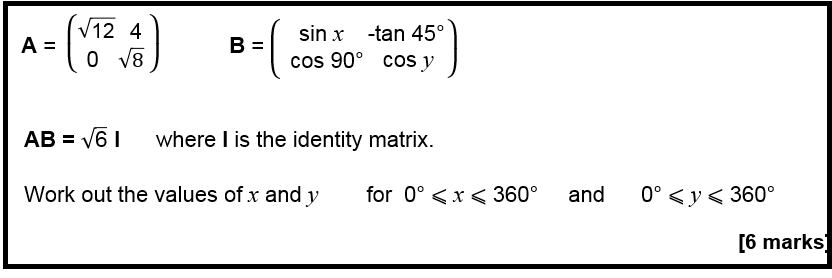
@1stclassmaths has also started to share a series of topic booklets for AQA Certificate of Further Maths. Their first one is on matrix multiplication.

 
Thank you also to @DrBennison for sharing an AQA A Level Maths Practice Paper 1 based on the 2022 Advanced Information.

2. ExamQ
Thanks to a comment on my GCSE revision blog post, I discovered the new website ExamQ from @ExamQbyMrWatts. This is a very well designed website where you can find exam questions that match each of the topics listed in the Advance Information. It covers GCSE, AS and A level. The website has a beautiful layout - it's user-friendly and it's free!


3. Maths Universe
@JakeGMaths has created a really smart teaching tool. mathsuniverse.com/whiteboard has lots of cool features. For example, say you're circulating round the classroom and you spot something interesting in a student's book that you want to share with the class. You can take a photo of it on your phone or tablet and it just pops up on the board instantly. No need for special software, equipment or logins. Then you can write on it, either from your phone or at the board. The user interface is lovely.

Another nice feature is instant replays. You can use this tool to model solutions on the board and replay your modelling in one click. It's so easy to use.


I also like the way you can easily display a PowerPoint that's on your PC and then use all the functionality - pens, timer, instant replay etc - over your slides.

While you're checking out mathsuniverse.com, have a look at the skills grid creator too. Again, a really clever interface - you can quickly create a series of linked starters and it automatically generates smart printable versions and worked solutions.


4. Ratio Tables
@alcmaths has gone through the entire White Rose Key Stage 3 and 4 curriculum and produced a brilliant guide to where and how ratio tables can be used.


5. Interwoven Maths
Some great new tasks have been added to @nathanday314's website interwovenmaths.com

@karenshancock wrote one on circle theorems that draws on simultaneous equations, ratio, and Pythagoras' Theorem. 


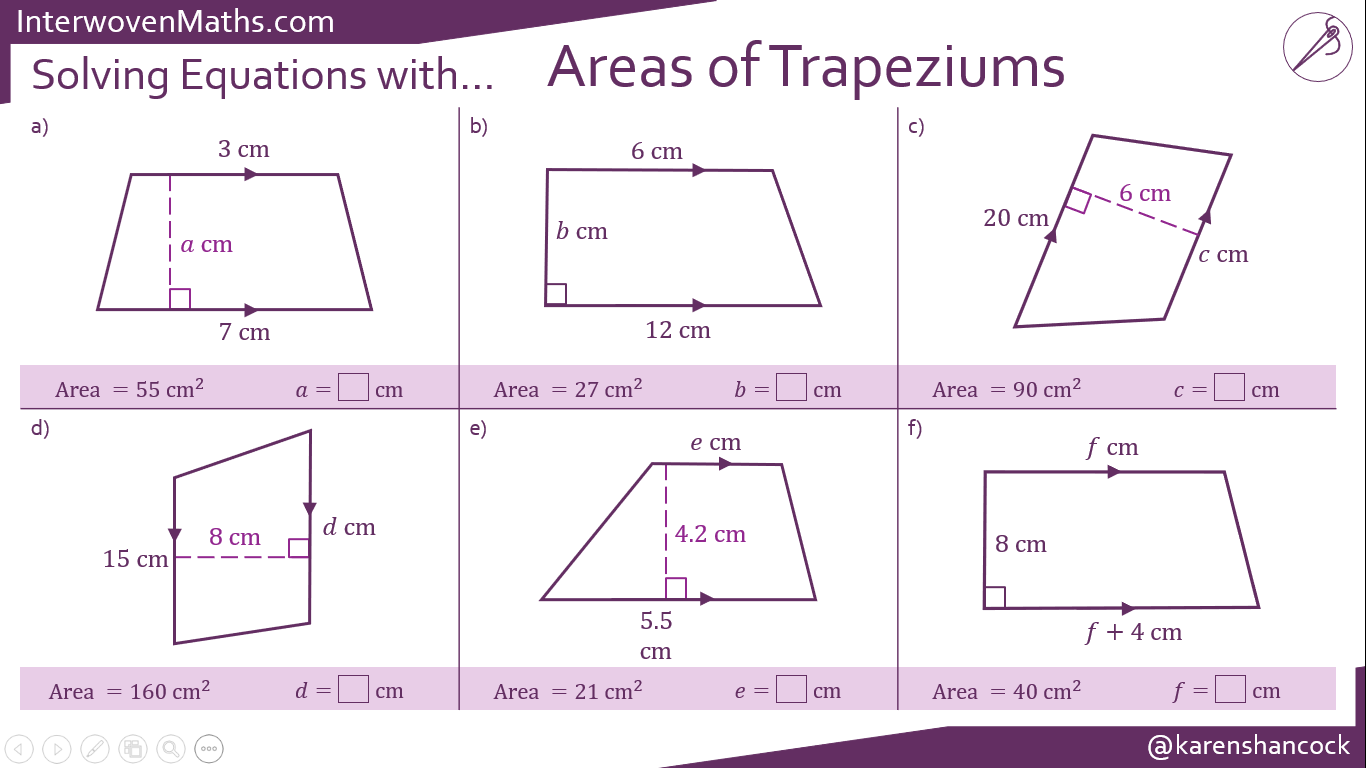
@karenshancock also wrote a series of tasks on areas of trapeziums which feature fractions, decimals, compound shapes and solving equations. 


Both tasks have been added to my resource libraries.

Update
I've been swamped at work lately so I haven't got much to report!

If you teach Year 11, good luck over the coming weeks! Exciting times.

I'll leave you with this incredible article "An Interactive Introduction to Fourier Transforms" from @jezzamonn. I have never seen a complex concept explained so clearly. It worth reading for two reasons: 1. to see how to construct a good written explanation and 2. to learn about Fourier transforms.


15 May 2021

5 Maths Gems #144

Welcome to my 144th gems post. This is where I share some of the latest news, ideas and resources for maths teachers. 

1. Tasks
I've spotted loads of great new tasks on Twitter in the last few weeks. 

@giftedHKO shared a nice area task - perfect timing for me as I'm teaching area to Year 7 next week. This task features amongst a collection of fantastic area ideas here.

@DanielPearcy's Year 10 class were struggling to remember negative indices and so he made this homework. It's so unusual to see negative indices in these contexts.


@ticktockmaths shared a lovely bounds lesson. I am a big fan of the format and structure of his slides as well as the content.


Another resource shared by Richard was this great starter Two or a half?.

Richard also shared a task where students are asked to find coordinate pairs to fit into Venn diagrams. What a great introduction to simultaneous equations! Richard got the idea for this task from @mpershan's excellent book Teaching Math with Examples


2. Self-Explanation Prompts
Speaking of tasks inspired by Michael's book, @karenshancock also shared an idea that came from Teaching Math with Examples: self-explanation prompts.


Karen has shared more examples of self-explanation prompts on her Twitter feed. To quote Michael's book, "The idea is to push students towards explaining ideas they might not even have realized they don’t understand. It’s also a useful chance to ask students to dig deeper and answer some “why” questions that can connect a procedure to concepts".

3. MathsPad
For many years MathsPad has been my first port of call for resources when planning lessons, and it's getting better and better. I have blogged before about their new range of topic booklets which are a bit like textbook chapters, but with far more depth and a greater range of activities than typical textbooks. They have published booklets for six topics so far: place value (which is free), calculations, negatives, fractions, indices and introduction to algebra. Here's an example of a task from the indices booklet:

4. A Level
In response to the disruption caused by the pandemic, the AMSP (@Advanced_Maths) has been working on six Support Packages for maths teachers and students. They bring together loads of resources, PD opportunities and support. AMSP material is always top quality and I'm sure these resources will be very helpful to students and teachers in Years 10 to 13. 


Thank you to @naikermaths for sharing six Year 13 statistics practice papers on their website.


And thank you to @Miss_Jethwa for sharing ten new A-level Further Maths papers on jethwamaths.com.

5. Methods
I love these creative methods that @staceymaths' students came up with to solve equations involving fractions. Clever stuff.

Mathematics in School
I am incredibly proud to have guest edited the latest edition of ⁦the MA's journal⁩ Mathematics in School with ⁦Ed Southall. It’s a tribute to Don Steward. If you're not a member of the MA then join now and you will be sent a copy. It's packed full of excellent articles.


Update
Did you see the Gem Awards post I published in April? If not, do check it out for a huge collection of amazing resources, ideas and websites to visit.


In the Easter holidays I attended a GLT Book Club meeting to chat about a chapter from my book A Compendium of Mathematical Methods. The recording of the session is here. I was really impressed by the quality of professional development in these book club meetings. 

Did you see @Mr_Rowlandson's blog post Thinking About Probability Trees? He is one of my favourite maths bloggers and his posts are always worth a read.

Don't forget to buy a ticket for the next La Salle maths conference which takes place on 10th July. I will be speaking about how to teach for depth instead of rushing ahead.


I'll leave you with a Don Steward task. Though it may look like a typical angles exercise, it was exactly what I needed recently when I was looking for a set of questions that only involved basic angle facts but had a good level of challenge. It reminded me of what an absolute treasure trove Don's blog is.


26 November 2019

Book Launch!

Back in September I wrote a blog post about the book that I've written. In that post explained why I wrote it and what it's all about. I submitted my manuscript at the end of the summer holidays and (naively) thought that all my work was done. In September and October I chose the design of the cover, gathered some reviews for the Amazon page and that was about it - it wasn't a huge amount of work. Then came November, and suddenly everything was really full on.

Getting the book ready for print was a much bigger job than I expected. I stayed up late into the night many times in November, working on checks and edits. My editor was brilliant and made lots of useful suggestions. The challenge came from the fact that all of my equations were retyped and therefore needed thorough checking, and all of the intricately detailed old textbook extracts were retyped too. It was an immense job to proofread every single line. If I wasn't a teacher I would have taken a few days off work to do it. But I had to fit it in around long days at work, getting my girls into bed, doing my marking and lesson planning, and everything else. In hindsight I think perhaps it was foolish of me to think I could be a full-time teacher and mum of two young children and write a book! But hey, I lived to tell the tale.

It's quite possible that an error will have made it through to the book, and I can only apologise for that. I worked harder on this than I've ever worked on anything before, and now it's being printed I feel rather emotional about it all. I feel relief, anxiety and happiness all at the same time. 

Because I never thought I'd write a book, and now I have, I really want to celebrate. Although I've organised and hosted two book launches and a number of other events in the past, I decided that I wouldn't be able to have a launch for my own book. My new job is really tough, and weekends and evenings in December are packed full of both work and family stuff, so I definitely don't have time to organise an event.

Thankfully my friend Emma McCrea (author of Making Every Maths Lesson Count) got in touch and offered to organise and host a launch party for me. I'm very grateful to her for working really quickly to get everything set up in time for the book's publication date. Tickets went on sale today, and I'm very excited about it.

The launch is on 14th December at SAMA Bankside, which is a bar near Blackfriars in London (those of you who stayed on for the Humble Pi afterparty might remember it!). The event is 3pm until 5.30pm. If anyone wants to stay out afterwards and turn it into a maths teacher Christmas night out then I'm up for that (it's optional though!). It's been a while since the last #christmaths so I think we're overdue a festive party... 

My little book launch will consist of maths activities, drinks, maths mingling, and two talks (one from me and one from the awesome speaker Zoe Griffiths). Tickets are £20 and this includes a copy of the book (hot off the press), a drink on arrival and all mathsy entertainment.

I know lots of people are going to be busy on the 14th, but I hope some people can join me to celebrate (I'm aware it's not ideal timing for a launch, but I really wanted the book to be out before Christmas).

You can book a ticket here. Feel free to bring partners and friends - this event is not exclusively for maths teachers, though the entertainment is all mathematical!

Hope to see you there. And if you can't come but still want to read my book, it's available to order here.


18 September 2019

Why Methods?

About 6 years I happened to stumble across a blog post about matrix multiplication. I was teaching FP1 at the time. I was surprised to discover a method I'd never seen before, and I showed my class the very next day. They liked it and asked why I hadn't shown them this in the first place. I admitted that I hadn't known about it.


I later showed this matrix method to my colleague Mariana. In that same conversation she showed me another method I hadn't seen before - the Factor Method for finding a Highest Common Factor and Lowest Common Multiple. It was a method that one of our students had introduced to us, and it turned out that some of my colleagues were already teaching it. I loved it.

I pondered these two methods - new discoveries for me - and wondered whether there was a book or website that had them all in one place. Where could I go to learn new methods? How could I find out what other teachers did? How could I share the two methods I'd just discovered with other teachers? It seemed unfair to keep them to myself when they'd surely be of interest to others.

I couldn't find anything about methods online, and this is what prompted me to start a blog. I thought that gathering together alternative methods in one place would help me remember what I'd found, and if anyone else happened to read it then it might help them too.

My first blog post - when I was just about to start maternity leave with my second baby in April 2014 - was about matrix multiplication. A couple of weeks later I wrote about Highest Common Factor. At that point a friend told me that people blogging about education should join Twitter, so I did. It was eye-opening. I immediately become immersed in the wonderful world of maths EduTwitter. There I found a community of teachers to discuss maths with. I learnt so much from them. It was a game-changer.

I didn't know enough interesting methods to only write about methods, so I started blogging about resources and pedagogy too. Resources began to take over because that was what people seemed interested in, but my curiosity about methods continued.

I went to my first maths conference in September 2014. I loved it. I noticed that the workshops were mainly about pedagogy rather than subject knowledge. So I decided that at the next conference I'd do my first ever conference presentation - I'd tell everyone my cool way to find a HCF and LCM, along with a few other methods that they might not have seen before.

At the next conference I was ridiculously nervous as I delivered my session but it was wonderful to hear a room full of teachers talking about methods. However at the end a man came up and told me that he'd already known all the methods I'd spoken about. This one little comment made me lose confidence in my idea to collect and share methods. I started to wonder if I was embarrassing myself by sharing stuff that was already widely known.

So I focused on resources for the next couple of years. I blogged about methods only occasionally, but I continued to think that subject knowledge development was the most important CPD maths teachers could do.

Back in December 2017 I was at an MA meeting in Leceister and picked up a few old textbooks from the archives. I was blown away by the quality of the questions in the exercises compared to many modern exercises. I immediately began to collect old textbooks, and quickly realised that they were full of fascinating methods and subject knowledge that had long been forgotten. This is what re-ignited my interest in methods. And this is what inspired me to bring all this fascinating stuff together in a book. I'd been saying for years that I'd never write a book. But I was overwhelmed by this big idea, and I couldn't stop myself from getting it all down on paper.

I started writing the book back in February 2019. It's not just about methods - it's a whole lot more. You'll have to wait and see what I mean when it comes out (I can't wait for you to see it!). I've never worked so hard on anything before. I worked on it every day of the summer holidays, and have been busy trying to get it finished off in the last couple of weeks, which has been really tough because I teach full-time and September is crazy busy. It was worth the effort though - I'm really excited about sharing it. I learnt so much writing this book, and now feel pretty confident that I know way more about mathematical methods than most people! My subject knowledge is miles ahead of where it was when I first qualified as a teacher.

I sent all 70,000 words of the book off to my publisher on Sunday. It might be out in December, but I'm not making any promises!

I've been on a five year journey from the day I first stumbled upon that matrix multiplication method. I've created something that didn't previously exist that I feel will be of great benefit to maths teachers. I really hope my readers like it. And if they don't, at least I will finally have what I wanted, for the benefit my own teaching - a plethora of awesome mathematical methods, all in one place.


27 December 2018

Factorising by Inspection

In 2018 I decided to write more short posts about approaches or methods that teachers might not have seen before. When I share these posts, I am well aware that there will be many people who already know the thing I'm blogging about, but I figured that it's still worth sharing even if it's only new to a handful of people.

My first post in this series was about using vectors for enlargements. Today's post is about a way to save time when factorising a non-monic quadratic expression (ie a quadratic where the coefficient of x2 is greater than 1) by inspection.

Back in September I had a post published a blog post for La Salle about methods for factorising non-monics. I showed that by looking at old textbooks we can see how methods have changed over time.

I explained that I prefer to factorise by inspection, but most teachers these days factorise by grouping (ie 'splitting the middle term'). In response to that post I had lots of teachers either (a) try to convince me that grouping is better than inspection (b) try to convince me that another method is better than inspection. Often teachers argue that their method is great because their students really liked it in the lesson, but I'm more interested in the extent to which methods 'stick' in the long term. When I used to teach factorising by grouping my students were always happy with it at the time, but a few months later they would struggle to remember the full procedure.

Factorising by inspection is intuitive and logical, so there's no procedure to memorise. I appreciate that most teachers still prefer the grouping method, and I do not intend to try to convince anyone to change their mind. But for those of you who like factorising by inspection, here's a tip from Susan Russo (@Dsrussosusan):

Let's say you have to factorise 6x2 + 17x + 12.

Factorising by inspection is super-quick once you get the hang of it, but here both 6 and 12 have multiple factors so this one might take a bit longer than others.

If you list all the possibilities and check each one, there are twelve cases to check.
(6x + 1)(x + 12)
(6x + 12)(x + 1)
(6x + 2)(x + 6)
(6x + 6)(x + 2)
(6x + 3)(x + 4)
(6x + 4)(x + 3)
(2x + 1)(3x + 12)
(2x + 12)(3x + 1)
(2x + 2)(3x + 6)
(2x + 6)(3x + 2)
(2x + 3)(3x + 4)
(2x + 4)(3x + 3)

Yawn!

An expert would probably work out the correct combination fairly quickly without writing down all the options. For a novice it's a pain that there are twelve options to think about here. At first it seems like it might take a while to select the correct combination.

Susan pointed out something which should be totally obvious but hadn't occurred to me before. We can teach our students to refine their guesses in order to make this method more efficient. Here's the key: each bracketed expression shouldn't contain any common factors. For example if you have a 2x then you can't put an even number in with it.

Let's look at that list again and immediately disregard any option where there's a common factor in one or both brackets.
(6x + 1)(x + 12)
(6x + 12)(x + 1)
(6x + 2)(x + 6)
(6x + 6)(x + 2)
(6x + 3)(x + 4)
(6x + 4)(x + 3)
(2x + 1)(3x + 12)
(2x + 12)(3x + 1)
(2x + 2)(3x + 6)
(2x + 6)(3x + 2)
(2x + 3)(3x + 4)
(2x + 4)(3x + 3)

It turns out there are actually only two cases to check by inspection. Students fluent in expanding brackets should be able to do it in seconds. You can immediately see that the first option will give a large coefficient of x, so we check (2x + 3)(3x + 4) and find that it works.

For some reason I've never shared this time-saving tip with my students. I'm very grateful to Susan Russo for bringing it to my attention. Let's try it again with one more example: factorise 12x2 + 11x - 15. Here's the massive list of 24 options to consider:

(12x + 15)(x - 1)
(12x + 1)(x - 15)
(12x + 5)(x - 3)
(12x + 3)(x - 5)
(6x + 15)(2x - 1)
(6x + 1)(2x - 15)
(6x + 5)(2x - 3)
(6x + 3)(2x - 5)
(3x + 15)(4x - 1)
(3x + 1)(4x - 15)
(3x + 5)(4x - 3)
(3x + 3)(4x - 5)
(12x - 15)(x + 1)
(12x - 1)(x + 15)
(12x - 5)(x + 3)
(12x - 3)(x + 5)
(6x - 15)(2x + 1)
(6x - 1)(2x + 15)
(6x - 5)(2x + 3)
(6x - 3)(2x + 5)
(3x - 15)(4x + 1)
(3x - 1)(4x + 15)
(3x - 5)(4x + 3)
(3x - 3)(4x + 5)

Removing those with a common factor in one or both brackets gives us this:
(12x + 15)(x - 1)
(12x + 1)(x - 15)
(12x + 5)(x - 3)
(12x + 3)(x - 5)
(6x + 15)(2x - 1)
(6x + 1)(2x - 15)
(6x + 5)(2x - 3)
(6x + 3)(2x - 5)
(3x + 15)(4x - 1)
(3x + 1)(4x - 15)
(3x + 5)(4x - 3)
(3x + 3)(4x - 5)
(12x - 15)(x - 1)
(12x - 1)(x + 15)
(12x - 5)(x + 3)
(12x - 3)(x + 5)
(6x - 15)(2x + 1)
(6x - 1)(2x + 15)
(6x - 5)(2x + 3)
(6x - 3)(2x + 5)
(3x - 15)(4x + 1)
(3x - 1)(4x + 15)
(3x - 5)(4x + 3)
(3x - 3)(4x + 5)

So this time we eliminated half the possibilities. It's not as time-saving as in the first example, but still helpful. My next step would be to try the less extreme numbers (ie not those involving a 12x or a 15) so that gives me only four options to test initially. For an experienced factoriser it's fairly quick to see that (3x + 5)(4x - 3) works.

Of course, in reality we never really list out all the options and then decide what to eliminate. What most people actually do when faced with 12x2 + 11x - 15 is write down (3x      )(4x      ) and then (often in their head rather than on paper) try some numbers that multiply to give -15. So it's helpful to remember that there's no point putting and 3 or a 15 in the first bracket.

This isn't a big game-changer and it doesn't help with every quadratic, but I like things that save us time. When solving a long, complicated problem at A level, it's good to able to factorise quadratics efficiently.

If you hadn't realised that you can quickly eliminate options in this way then I hope this was helpful.

If you want to have a play with this, there are lots of non-monic expressions to factorise here.


22 September 2018

Vectors for Enlargement

I'm going to do a series of short posts on approaches or methods that teachers might not have seen before. I'm very aware that there will be many people who already use these approaches, but I figure that not everyone will have seen them so they are worth sharing.

Today, vectors for enlargements. I first saw this on Twitter years ago but I can't remember who tweeted it (apologies!). Later I saw my former colleague Lizzie Stokes (@misstokesmaths) using this approach in her teaching.

How I used to teach enlargement
I'll illustrate my previous method with a negative enlargement question:
I'd tell my students to draw a line to any vertex from the centre of enlargement. Then I'd tell them to count how many squares they've moved to get to the first vertex. I always modelled this slowly on the board. I showed the process of counting carefully ('count the corners, not the spaces!') because I find they often miscount.

Then I circled the scale factor and said that because the scale factor is negative two, to find the image they have to double the distance from the centre of enlargement. But because it's negative, they have to go in the opposite direction from the centre. So in this case, we started by going two units right and one unit up so now we have to go four units left and two units down. I emphasised that we're going the opposite direction because it's a negative enlargement. We then do the same thing for each of the other vertices in turn. At the end, all the corresponding vertices should be joined with straight lines going through the centre of enlargement. If not, you've miscounted!

I'd show another example with a different scale factor, then get them to practise a lot of these on printed worksheets. It was normally a relatively quiet lesson as they all had to do a lot of counting! I'd go round berating them for using pen when I'd told them to use pencil ten thousand times.

In hindsight I realise that this method could be better. It works fine for super smart students (most things do!), but others struggled with it. One problem is that you have to hold lots of details in your head while you work though the question. Another problem is that the method is different to the method for positive enlargement - there's an extra thing to remember.

How I now teach enlargement
They start by labelling each vertex with a letter and then finding the vector that takes them from the centre of enlargement to each vertex. They are already fluent in using vectors from our work on translation so this should be straightforward.

They write down the vectors rather than trying to hold the information in their head like they did before. Then all they have to do is multiply each of their vectors by the scale factor, and this gives them the vector for each of the vertices of the image. So they know exactly where to draw the image - it's all calculated and recorded before they start drawing.
I've used 'Year 11' vector notation in the picture above for clarity, though it's not essential at this stage.

This method is identical regardless of whether we are enlarging with a positive or negative integer or a fraction. So suddenly negative enlargements are no harder than positive enlargements (assuming students know how to multiply negatives). A clear and consistent method all round - I don't know why I didn't always do it like this.

Any others?
I hope that was helpful if you'd not seen it before!

I've blogged a number of times before about alternative methods for various topics (see my posts tagged 'methods'). If there are any approaches or methods that you use that you think other teachers might not use, I'd love to hear them! Please comment below or email me or tweet me.


30 May 2018

Algebraic HCF and LCM

The topic 'Highest Common Factor and Lowest Common Multiple' is one where there's a lot of scope for subject knowledge development. There is so much for both teachers and students to explore in this topic. Ask a group of maths teachers how they find the highest common factor of two numbers and I expect a number of different methods will be mentioned. There is no universally accepted 'best way'. I wrote about a number of alternative approaches back in 2015.

Identifying Highest Common Factors
When I think of highest common factor questions, I think of questions involving integers. For some reason I've never taught a lesson on 'Highest Common Factor of Algebraic Terms'. On reflection, I think it might really help develop student understanding of the underlying concepts.

Look at these two examples:

Find the Highest Common Factor of 420 and 96
Find the Highest Common Factor of 10ab and 5a2b2

In the first case we want to find the greatest integer that is a factor of both 420 and 96. The most conceptually clear approach is to list all the factors of 420 and all the factors of 96 and then find the biggest factor that's on both lists. But it can take a while to list all the factors, so we often use primes to arrive at the answer more quickly. We write

420 = 2 x 2 x 3 x 5 x 7
96 = 2 x 2 x 2 x 2 x 2 x 3

Many students then use a Venn method to identify the highest common factor. I suspect that although students can follow the Venn procedure fairly easily, they may not really know what's going on. When teaching this from first principles, it's helpful to rewrite the factors like this

420 = 2 x 2 x 3 x 5 x 7 = 12 x 35
96 = 2 x 2 x 3 x 2 x 2 x 2 = 12 x 8

And then it's so much clearer why 12 is the highest common factor.

The extract below is taken from 'New General Mathematics' (first published in 1956 and still in use in the 1980s). We can see the conceptual understanding being embedded much more carefully than it is now. Whereas modern textbooks often jump straight to questions like 'find the HCF and LCM of 45 and 60', which requires a number of separate skills, here we can see isolation of the specific skill 'identify the common factors'. This seems a far more sensible starting point from a cognitive load perspective.

Students are not required to do the prime factorisation first, nor are they being asked to find both a HCF and LCM. They are simply selecting the common prime factors. In the first question, all three numbers contain 3 x 3, meaning they are all multiples of 9. There is no other factor that appears in all three numbers, so 9 is the highest common factor. Later in the exercise students will need to do the prime factorisation themselves, but not yet.
Of course, the idea is the same for the algebraic terms. But it's easier, because it's immediately clear what the algebraic factors are:

10ab3 = 2 x 5 x a x b x b x b = 5ab2 x 2b
5a2b= 5 x a x a x b x b 5ab2 x a

For numbers, finding a highest common factor can take a bit of work - it's harder to identify the factors of a number than the factors of an algebraic term. But the underlying mathematical concept is identical. Perhaps it might even be better to start with algebra before moving onto numbers.

Factorising with Highest Common Factors
Factorising an algebraic expression by identifying the highest common factor of two or more terms is relatively easy once you understand how index notation works.

10ab+ 5a2b2  = 5ab2(2b + a)

We don't often factorise in the same way with numbers, but it's fun to play with:

 Factorise 56 + 42

Here we take out the highest common factor, giving us 14(4 + 3). And this is nice, because we can now see that 56 + 42 is the same as 14 x 7. That's because it's four lots of 14 plus three lots of 14.

Here's another one:

Factorise 24 + 36

Here we take out the highest common factor of 12, giving us 12(2 + 3). So we can now see that 24 + 36 is the same as 12 x 5. Which is obvious when you think about it, because it's (12 + 12) + (12 + 12 + 12). It's fun to play with numbers like this.

There are plenty of fun numerical factorisation questions in textbooks, old and new.
Identifying Lowest Common Multiples
Identifying lowest common multiples using primes can be quite conceptually challenging. Students can be successful when using Venn methods and similar, but I bet few would be able to explain how their method works.

I like this introduction from a 1950s textbook for starting to build an understanding of what's going on:

What factors must necessarily be in a number so that 2, 5 and 7 will divide into it exactly?

What factors must necessarily be in a number so that 3, 2 x 3 and 3 x 5 will divide into it exactly?

What factors must necessarily be in a number so that 4x, 2ax and 6a will divide into it exactly?


I think it might be worth developing this as a starting point when introducing this topic.

At primary school, students learn to add and subtract fractions using lowest common denominators, but they may not realise that in doing so they are actually finding LCMs. I wonder if we could make better links to this prior knowledge.

Questions for Developing Fluency
This question came up in an AQA mock last year:
AQA GCSE Practice Set 4 (Paper 1H) 

When marking this I noticed that although I hadn't covered it directly with my students, most were able to work it out using their understanding of HCF and LCM.

Later I stumbled upon a huge set of questions just like this! The extract below is from Elementary Algebra for Schools, a textbook from the late 1800s that has been fully digitised.

It makes a lot of sense to develop fluency here, before moving onto related skills such as factorisation into single brackets and simplifying algebraic fractions.

The book takes this concept a lot further, looking at LCMs and HCFs of compound expressions including quadratics and cubics.
This chapter on algebraic lowest common multiples comes before the chapter on 'Adding and Subtracting Algebraic Fractions'. This makes a lot of sense!

When I teach adding algebraic fractions I don't directly teach the separate skill of finding the LCM of algebraic expressions beforehand. Perhaps I should. To add or subtract algebraic fractions like those shown below, there are a number of key skills:
1. identifying the lowest common multiple of the denominators
2. converting fractions so they share a denominator
3. adding the numerators once the fractions have the same denominator
4. simplifying
There's a lot going on here. We need to take these skills one at a time.
There are dozens more pages on algebraic highest common factor and lowest common multiple in this Victorian textbook. It was clearly a big part of secondary school mathematics in the 1800s.

There are similar activities in textbooks from the 1950s. They contain loads of practice on HCF and LCM of algebraic terms and expressions.
In stark contrast, there are only a handful of relatively simple questions in a modern GCSE textbook on the same skill:

It's funny how things change.

I hope you've found this useful, or if not useful then at least interesting! If you have anything to share regarding algebraic highest common factor and lowest common multiple, please tweet me or comment below. Thanks for reading.