Welcome to my 176th gems post. This is where I share some of the latest news, ideas and resources for maths teachers.
1. 1st Class Maths
1stclassmaths.com has always been full of incredibly high quality resources, and the recent additions are no exception. The GCSE revision resources (designed for both Edexcel and AQA) contain original GCSE-style questions which are very well written.
I also love the question frequency data on the Topic Appearance page. There's so much interesting analysis here!
2. MathsBot Games
I'm enjoying @StudyMaths' revival of old Flash Maths games. For example Find the Primes is really fun and easy to use. I enjoy playing this with my Year 7 daughter! It's a bit more accessible for her age than IsThisPrime? which is also awesome.
I was always a big fan of Flash Maths back in the day. My favourites were Shape Shoot and Memory Maths, which visitors used to play on Open Evenings at my last school.
3. Tasks
Here are some great tasks I've seen on Twitter over the last few weeks:
It's great to see lots of newly improved resources being published by Dr Frost's team. For example @nathanday314 has created excellent slides and exercises for angles in parallel lines.
Follow @DrFrostResource for updates on all the new resources being released.
5. Function Machines
PolyPad from @mathigon has a brilliant new function machine tool. It's very easy to use and a fantastic way to illustrate composite and inverse functions. Have a play with it. For me it's perfectly timed as I'll be teaching this topic to Year 11 next week.
Maths Week
We ran a Maths Week at my school last week (not in the same week as Maths Week England, because that clashes with Anti-Bullying Week). It was a very successful event with loads of engagement from students across all year groups. We designed it to be high impact without an excessive workload, with lots of opportunities for all students to earn House Points (not just the best mathematicians).
We ran a Teacher Treasure Hunt using the fantastic resources created by @missradders. We had over 170 entries and it was wonderful to see the level of enthusiasm amongst students. They loved it! We will definitely make this an annual event.
We ran a daily puzzle, which we displayed around school and in tutor time notices. We were delighted by the level of engagement. It was such a joy to see students crowded around puzzles in corridors discussing their ideas and solutions. There's an example below (many students and teachers struggled with the third sequence, though it's wonderfully simple when you spot it - I got it from a Complete Maths conference!).
We had a Sparx XP competition and we were shocked by how much Sparx usage increased as a result!
Our wonderful librarian set up a special display of maths books in the library and promoted them throughout the week.
I delivered an assembly to each year group on 'How I Fell in Love With Maths', the idea being that one day they'll find something that they are so passionate about that they want to talk about it all the time. My assembly centred around Fermat's Last Theorem, which I think is a story everyone should be told. I also wore a different maths dress for each assembly!
Update
If you didn't see the news about this - GCSE teachers should be aware that Year 11 might get the formula sheet in their exams this summer. This comes as a surprise, but a good one - even though I think the design of the formula sheet is poor, I'm in favour of formulae being provided with exams (every year, not just in 'covid years'). The consultation closes on 30th November.
Finally, as Christmas is coming I thought it might be a good time to mention that my book A Compendium of Mathematical Methods makes an excellent present for a maths teacher.
Welcome to my 163rd gems post. This is where I share some of the latest news, ideas and resources for maths teachers. The new school year has brought a flurry of activity on Twitter, with tonnes of great resources being shared over the last few weeks. 1. Zeroes and Ones
@TickTockMaths shared a couple of nice tasks to prompt discussion about writing superfluous digits.
Thanks to @mrshawthorne7 for sharing a great task for finding the equations of linear graphs where there's variation in the scaling of the axes. Charlotte says there’s some nice discussion to be had around Questions 1 and 4 (they're the same equation but ‘look’ different) and Question 5 and 6 (they ‘look’ the same but are different equations). The full resource features a mix of positive, negative and fractional gradients and some questions where given the equation the students need to label the axes. It can be downloaded from sketchcpd.com.
4. Nets Thank you to @joann_sandford for sharing a feature of @MathigonOrg's Polypad that I didn't know about. You can use it to create and test nets of 3D objects. Check out the gifs below where I had a little go myself. In the second gif you can see what happens if you make an incomplete net. It's very easy and it's fun!
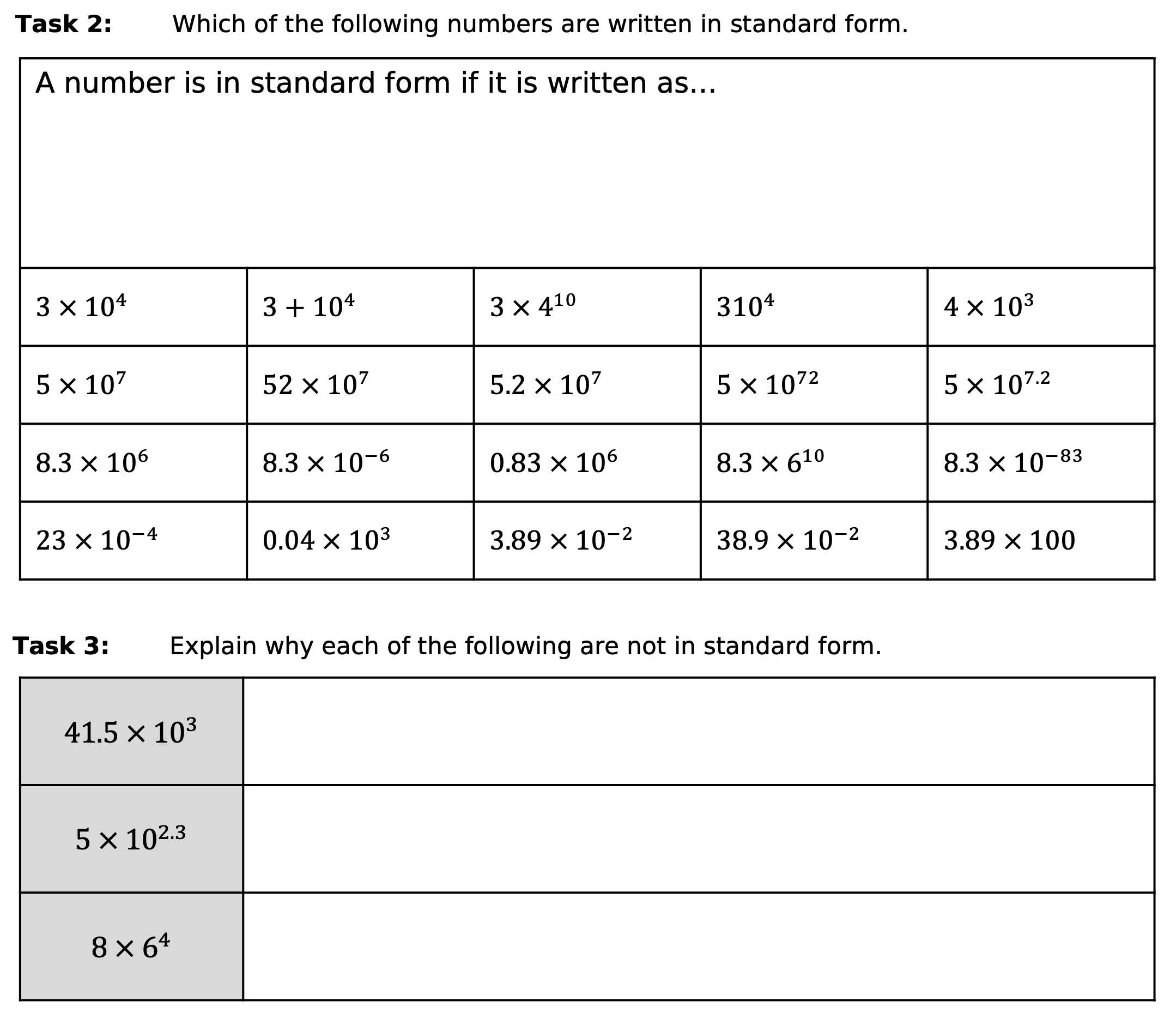
I've also seen some excellent tasks on standard form from both @MrE_Maths and @nathanday314.
@MrE_Maths shared a thread with lots of tasks featuring both scaffolding and challenge.
And @nathanday314 shared a thread and resource showing his approach to teaching standard form, including his narrative on the history and usage of standard form.
Conferences
Somehow I ended up presenting at three conferences in four days, which was stressful and a lot of hard work, but brilliant. I do love a maths conference.
On Wednesday I was at the Pixl Conference at The Oval in London. I'm not a Pixl member so it was fascinating for me to get an insight into how Pixl supports maths teachers through high-quality CPD, apps, resources and assessment (for example they provide mock exams - the kind that students won't be able to find online! - and grade boundaries). It's a really good model. The conference itself was a bit different to usual - it was a series of very short sessions, which meant it was buzzy and high-energy with lots of quick ideas. I did a ten minute keynote on challenge. It was a fun day, and the lunch was absolutely delicious!
On Friday I was at the Harris Federation conference. I work for a Harris school - every year all Harris staff have an Inset in October at the Excel Centre, with well over 4000 people attending. In the middle part of the day everyone goes to a role-specific session. I was asked by the maths consultant team to run the Key Stage 3 maths room which had around 130 delegates in it for a 2.5 hour session. This is a long time to run a room by myself, so in the middle part of the session I had everyone spend time trying out some challenging Key Stage 3 tasks from mathsvenns.com, Don Steward, MathsPad and mathshko. Everyone got really stuck into these tasks which was great. It was ironic that I shared excellent Don Steward tasks when Harris Federation has blocked access to Don Steward's website in all Harris schools, and despite my requests they will not unblock it. Incredibly frustrating. Anyway, if you attended this session then thank you for your excellent engagement - if you work for Harris and you want the slides, the maths consultant team will share them after half-term.
On Saturday I was in Manchester for #mathsconf30. This was brilliant. With Rob Smith running a full tuck shop, it felt like a real return to the full pre-covid experience. I attended some excellent sessions and really enjoyed chatting to lots of teachers, many of who were at their first in-person conference. I presented on Area in Depth which seemed to go well, despite some weird projector problems! If you attended my workshop - thanks very much for coming - you can access my slides on my Topics in Depth page. After the conference, Craig Barton and I recorded a podcast at Piccadilly Station where we shared our top tips from the conference. It's a super-short podcast (under half an hour!) so do have a listen.
If you attended any of the three workshops I delivered this week and you want to say thank you, you can buy me a drink here or support me by paying £4 a month on Patreon. Many other maths websites have adverts that provide an income stream but I don't have any adverts to help cover the cost of hosting my website. So any donations are gratefully received. Thank you!
Update
At all three conferences people asked me how my new role is going. I'm really enjoying being Head of Maths. It's nice to do a role I feel so confident in. I'm lucky I get to work with such a great team. I might blog about some Head of Maths stuff over half-term.
My brilliant colleague Morgan made an amazing door display with her tutor group for Black History Month. It's fabulous. She got the graphics from Twinkl. Nira Chamberlain, who is featured on the display, tweeted about it:
— Professor Nira Chamberlain OBE PhD HonDSc 🇯🇲 (@ch_nira) October 14, 2022
Over the last few weeks I've been attending Open Days at my local schools. We're choosing a school for my eldest daughter Maddie who is in Year 6. My nearest secondary school is a Catholic school which she won't get into. We live in a grammar school borough but we decided not to enter her for the selection tests, so that left us with four comprehensive schools to look at, including my own. All the schools we looked at had brilliant maths departments - it was so interesting to get the chance to look around!
My school's Open Day tour ran as a self-guided route around the school. The maths department was set up in the canteen. This gave us tonnes of space so we put maths puzzles out on three big canteen tables, and I was delighted that all three tables were quickly full of Year 6 children and their parents doing maths together, assisted by our brilliant student helpers. The engagement in these puzzles was incredible.
Open Day today. Massive amount of engagement in the puzzles we put out. Loads of parents sat down and had a go with their children which was fantastic to see. Loved having a room full of adults and children doing maths together. ❤️ Source: https://t.co/9Cz0dvjL0opic.twitter.com/TQVlXltnXB
My school is a fairly new building and we have tried to keep things uncluttered, so the maths corridor has plain walls and - until recently - nothing mathematical about it. One of the first things I did when I became Head of Maths was to add a bit of personality - we now have a lovely wall sticker. Sticking this up during a lunch break was very intense!
Here are some blog posts and resources you might have missed:
My favourite maths blogger @Mr_Rowlandson blogged about Pythagoras following his #mathsconf30 talk. I was gutted I couldn't attend this talk - it was on at the same time as mine.
@my_mathsticks blogged about how he uses etymology in his teaching. He has a book coming out next month called Mathematical Etymologia. This is exciting - I love this kind of thing and talk about it a lot in my lessons.
The Mathematical Association announced the dates of its next annual conference. It will take place at the University of Warwick on 3rd and 4th April. It's a joint conference with all the maths subject associations. Save the date - this will be great!
With the return of the dubiously worded GCSE formula sheet, it's worth reminding ourselves of resources which might help students practise using it: Dave Taylor shared this resource in April and Mel at JustMaths shared this blog post.
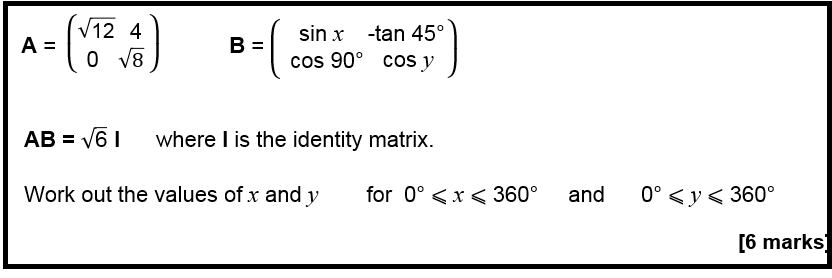
I'll leave you with three nice problems for you or your students.
Welcome to my 158th gems post. This is where I share some of the latest news, ideas and resources for maths teachers.
1. Revision Resources Back in 2018 I created three sets of 'breakfast revision' resources for both Foundation and Higher GCSE (note: they don't have to be used at breakfast!). Jess Prior (@FortyNineCubed) has edited these for the Edexcel Advanced Information 2022. Thanks Jess!
Based on @mathsjem's GCSE breakfast revision resources, I've created a set for 2022 Paper 1, using the Edexcel advanced information. There are four different levels of difficulty (two higher, two foundation) with answers, and an editable version. https://t.co/MuhtFwwH9rpic.twitter.com/z3gtLCEMeU
Thanks to a comment on my GCSE revision blog post, I discovered the new website ExamQ from @ExamQbyMrWatts. This is a very well designed website where you can find exam questions that match each of the topics listed in the Advance Information. It covers GCSE, AS and A level. The website has a beautiful layout - it's user-friendly and it's free!
3. Maths Universe @JakeGMaths has created a really smart teaching tool. mathsuniverse.com/whiteboard has lots of cool features. For example, say you're circulating round the classroom and you spot something interesting in a student's book that you want to share with the class. You can take a photo of it on your phone or tablet and it just pops up on the board instantly. No need for special software, equipment or logins. Then you can write on it, either from your phone or at the board. The user interface is lovely.
Another nice feature is instant replays. You can use this tool to model solutions on the board and replay your modelling in one click. It's so easy to use.
I also like the way you can easily display a PowerPoint that's on your PC and then use all the functionality - pens, timer, instant replay etc - over your slides.
While you're checking out mathsuniverse.com, have a look at the skills grid creator too. Again, a really clever interface - you can quickly create a series of linked starters and it automatically generates smart printable versions and worked solutions.
4. Ratio Tables @alcmaths has gone through the entire White Rose Key Stage 3 and 4 curriculum and produced a brilliant guide to where and how ratio tables can be used.
Ratio tables mapped throughout the @WRMathsSec curriculum, building from year 7 to year 11 content.
MA President @colinfoster77 's latest blog post offers a sense-making approach to learning multiplication facts.
Did you read my Gem Awards 2022? It's full of amazing resources so do check it out.
If you teach Year 11, good luck over the coming weeks! Exciting times.
I'll leave you with this incredible article "An Interactive Introduction to Fourier Transforms" from @jezzamonn. I have never seen a complex concept explained so clearly. It worth reading for two reasons: 1. to see how to construct a good written explanation and 2. to learn about Fourier transforms.
Welcome to my 156th gems post. This is where I share some of the latest news, ideas and resources for maths teachers.
1. GCSE Revision
Revision season is upon us! If you're looking for GCSE revision resources then do check out my recently updated GCSE revision resources page. With over 110,000 views since it was first published in November 2016, it's my most viewed blog post ever.
If you're specifically looking for material related to the Summer 2022 Advance Information, then look at @Noni_Rainbow's padlet which includes numerous checklists and resources.
@1stclassmaths has generously shared a free set of practice papers for this summer's exams for both AQA and Edexcel. They are also producing practice papers for AQA L2 Further Maths: Paper 1 is here and Paper 2 is coming soon. Here's an extract:
White Rose Maths has also published a set of practice papers made specifically for Summer 2022 GCSEs.
And speaking of revision, it was good to see @steelemaths share a thread explaining his approach to GCSE revision this year. It's worth a read.
2. Dr Austin Maths
At my school we've been making a lot of use of resources from draustinmaths.com lately. Although I've blogged about these resources a few times before, I know there are still a lot of teachers who haven't yet discovered them, so do check them out if you haven't already! Many of them are linked in my resource libraries, but the best way to browse is at draustinmaths.com which has recently been upgraded to improve the navigation functionality.
Resources are now grouped by topic, for example you can view the surds resources here and the averages resources here. Here's an example of a resource I recently used with my Year 10s - they found it more challenging than I expected them to (in my experience, students always find bearings surprisingly tricky!).
I've featured this website in a gems post before - many years ago - but had forgotten about it. It's a great website with loads of puzzles which may be suitable for students at Key Stage 2 and 3. Here are a couple more examples: first, Drafters Puzzle #2 which will come in handy if you're teaching plans and elevations. Students have to work out what the solid looks like:
A related puzzle for plans and elevations is here.
Second, The Four Paths Problem. I've seen this before but always forget to share it with my students.
4. Resources Here are some examples of the lovely resources that have been shared on Twitter recently.
@alcmaths shared an activity on error intervals and numbers lines. For some reason I have never thought to do this before - next time I teach error intervals I will make sure I include number lines!
You can download this resource, and many more, from Amie's blog.
@nathanday314 shared a resource for comparing coefficients in identities, including algebraic fractions. The editable PowerPoint is here and the PDF is here.
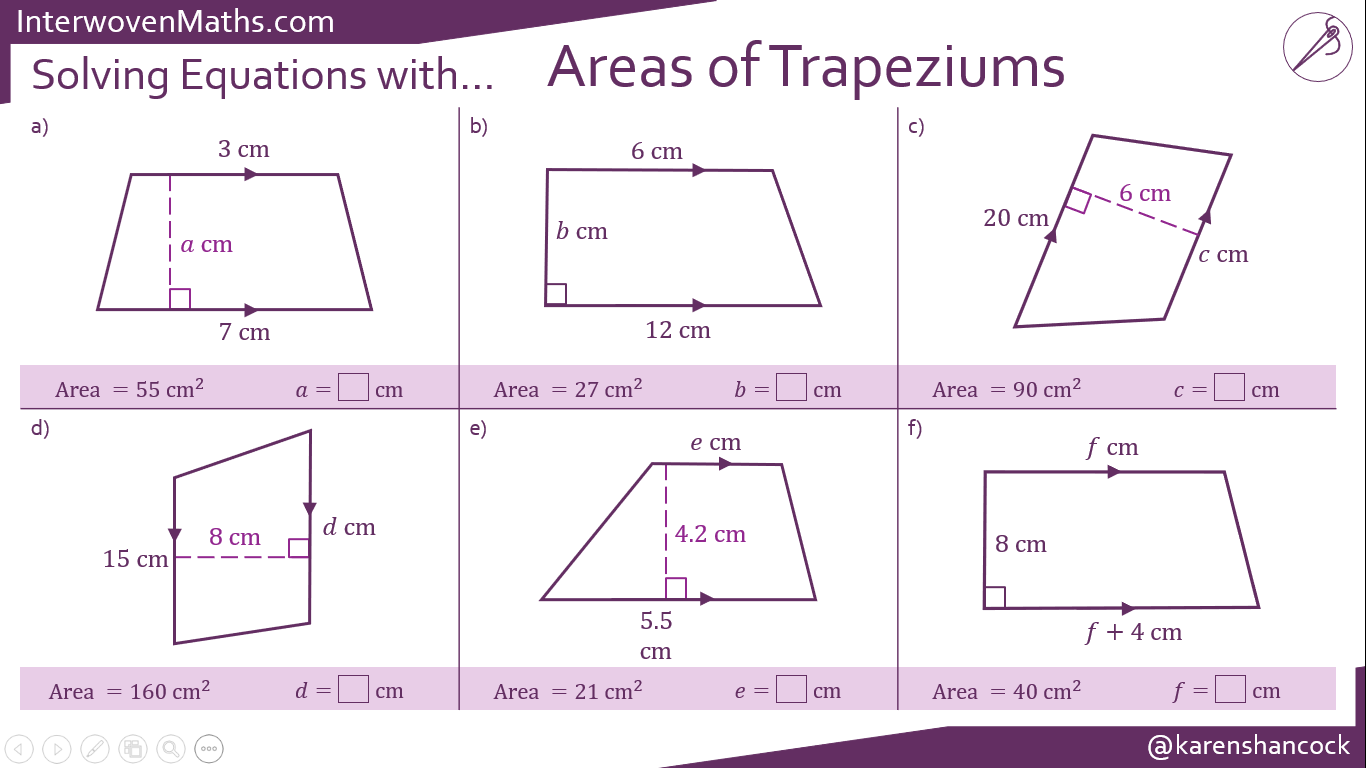
@drpas1001 had a great idea for an exercise to get students reasoning with area and perimeter of circles and sectors. You can download it from TES.
@giftedHKO shared a fantastic ratio task to get students thinking about which statements are always, sometimes or never true.
@hartmaths wanted his Year 11 students to show more detail in their working so he took a set of past Edexcel Higher GCSE questions and made them into 'show that' questions. You can download this resource here.
5. A Level Calculator Tips
@BicenMaths has published a video containing top calculator tips for A Level maths. This covers both the fx-CG50 Graphics and the fx-991EX Classwiz models (skip to 31 minutes for the Classwiz). This will be helpful for students taking A Level maths, and also for teachers who are new to using these calculators.
Update
The Easter conferences are a grand tradition in maths education. Before the days of the internet, they were the primary mechanism for teachers, researchers and other members of maths education communities to come together and collaborate and develop the profession. I'm a big fan of these conferences and am really looking forward to the MA Conference next week. The first two days are online and the final day is in Stratford-Upon-Avon. It's not too late to get a ticket! There are loads of fantastic sessions on the programme. Even if you can't attend next week, buying a ticket for the virtual conference (which is only £15) means you'll have access to all the online workshops afterwards.
I'm doing the first keynote on Tuesday (I'm very nervous).
If you're coming to the in-person day in Stratford and you're staying on the Wednesday night, do join us for pre-conference drinks. We'll be in the Pen and Parchment from 7.30pm. All welcome - if you don't know anyone, look out for me - come and say hello.
In other conference news, the MEI Conference is now open for booking. This event takes place in Keele on 30th June and 1st July. It's always a fantastic conference. I'm looking forward to delivering a workshop on the second day.
Have you got a copy of my book A Compendium of Mathematical Methods? If not, have a look at what education guru Dylan Wiliam says about it. 😀
I like to think I know quite a lot about mathematical methods at school level, but I was blown away by @mathsjem's "A compendium of mathematical methods" https://t.co/O5LzpXSeip. It includes every technique I could think of, and dozens more that I didn't know. Highly recommended.
Finally, a shout out for the Glyn Maths Department! They kindly invited me to their end of term social. We did an Escape Room, which I love! What a fantastic bunch of people.
I'll leave you with this joke, shared by @OFalafel, which made me smile.