6 September 2014

5 Maths Gems #5

Twitter is a different place now everyone's back at school. During the day it's really quiet because teachers are hard at work, but in the evening it comes alive again. Despite being the first week of term, the UK maths twitter chats (#mathscpdchat on Tuesdays and #mathschat on Wednesdays) were as busy as ever - as usual they gave me plenty of inspiration.

This week also saw the return of teacher blogs. I really enjoy reading reflections of what teachers have been trying in their lessons, what went well and what didn't. These blogs are a fantastic source of ideas.

This fifth weekly gems post is (unintentionally) brought to you by the letter P. It features patterns, puzzles, primes, projects, plenaries and posters.

1. Patterns and Puzzles
Fawn Nguyen's (@fawnpnguyen) excellent website visualpatterns.org has over 100 patterns. Students are asked to think about what step 43 looks like in each sequence. Fawn's website is a collaborative effort with contributions from dozens of teachers. Further contributions to the website are welcomed. The patterns can be copied and pasted into worksheets for maths lessons. This week @JemmaPDuck wrote a lovely blog post about a successful lesson in which her students were really engaged in exploring these sequences.

Sticking with visual maths, Denise Gaskins (@letsplaymath) shared a puzzle from the website 1001 Visual Puzzles. I explored this site and found that it's full of very unusual and original puzzles. I also learnt a little about topology - what a bizarre branch of mathematics. Here's an example of a topological puzzle (students would need to refer to a map of South America for this):
2. Primes
Primes are really interesting, aren't they? I've seen some great stuff on primes this week.

Richard Green (@edfromo) is a mathematician who posts regularly on Google+. He writes really interesting things about a wide range of mathematical topics. He often features animations which you'll know I'm a fan of if you read my post about animations and simulations. For example this is a very clear explanation of Mersenne primes and perfect numbers.

If you're thinking of doing something on primes with your students, @the_chalkface shared this excellent true or false activity which students will find interesting and stretching.

I also like this activity 'Further Factor Properties' from @TeachitMaths, mainly because it involves sexy primes and I'm a bit immature like that.

4. Projects
I've never thought of textbook redesign before, but it could be a really good mini-project at the end of a topic. On @JemmaPDuck's blog she says that she showed pupils a boring maths textbook and challenged them to come up with a different page on the topic they'd studied. The new page should be informative, well presented, clearly explained and contain challenging questions. I love this idea and it's perfect for peer assessment. It would also work well in a revision lesson. You could pick the best page for each topic and create a whole textbook designed by your students.

4. Plenaries
How do you end your lessons? Exit tickets? Diagnostic questions? Texts or tweets? Suffolk Maths has a helpful Plenary Review Grid with lots of good ideas.

Zoe Elder (@fullonlearning) shared this BBC article via @katiecpd '10 things we didn't know last week'. I learnt from this that Hello Kitty is not a cat! The article is worth reading every week and could be useful for tutor time. It would also make a nice plenary activity in maths lessons. Perhaps once a week students could brainstorm '10 things we didn't know last week' in terms of what they've learnt in maths. They may be surprised by how many new things they've learnt.

5. Posters
The maths periodic table display by @Just_Maths would be a fantastic addition to any maths classroom or corridor. By the sound of it, many maths teachers up and down the country have devoted a few hours of their time this week to making this awesome display. Here's a great example from Tim Jefferson (@DocendoTim).


Tom Riley (@riley_ed) shared this picture of a staircase to a maths department, which features primes, squares, cubes, times tables and formulae.


I love this post by Lois Lindemann (@MoreThanMaths) about her aims for the year, where she shared a fantastic idea - she asked students to draw portraits of their maths teachers. What a lovely way of celebrating their artistic talent.

Finally, I also spotted this excellent idea for a simple but effective message from Cristina Milos (@surreallyno). I had fun making a poster out of this message using postermywall.com.
While I was in a creative mood, I made some posters of @joboaler's positive norms messages. As I said last week, I don’t actually have my own classroom to decorate but hopefully someone will find them useful!

Resourceaholic.com update
I'm really pleased to see that my blog is being used by teachers to access great resources. This week I wrote a post about teaching Pythagoras' Theorem and added a topic specials page so you can quickly find similar posts. I also had a rant about student targets in which I questioned whether they are effective or even necessary. After Ed Southall (@edsouthall) shared these awesome wall decals, I updated my mathsy gifts page. I've also added a couple more homeworks to the Pret homeworks page.

How good are you at drawing lines of best fit? Test yourself here (thanks to @MARitchings) - fun for teachers and also a useful lesson resource.

Finally - look, Spiked Math has a similar idea for name learning to the one I mentioned in my last maths gems post.


2 September 2014

Pythagoras' Theorem

Pythagoras' Theorem is one of my favourite topics to teach. In my experience, students quite like it too. At first they may be intimidated by the new and seemingly complex mathematics. It's probably the first time they've seen words such as theorem, proof and hypotenuse so no wonder they're apprehensive. But they'll quickly get the hang of it.

When A level students have to find the distance between two points or verify that a triangle is right-angled, their first thought should be Pythagoras. By Year 12, Pythagoras' Theorem should be a staple in their mathematical toolkit, along with other skills such as arithmetic, fractions, simplifying algebra, using index laws and factorising quadratics. In my opinion these things are the bread and butter of secondary school higher mathematics.

I'm going to touch briefly on proofs at the end of this post but my main focus is on interesting Pythagoras questions and resources for Key Stage 3 and 4. Before we start, I should issue my usual caveat - there's absolutely loads of excellent Pythagoras resources online and here I'm just showcasing a small selection.

Interesting Questions
It's not always necessary to force a question into a 'real world' context to make it engaging. Problems don't have to be contextual to be interesting - sometimes the very best questions are abstract but accessible.

In this example from illustrativemathematics.org, students have to work out whether the shaded triangle is right-angled.
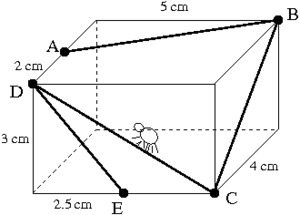
This Spiderbox question, also from Illustrative Mathematics, appears at first glance to be a 3D Pythagoras question but actually the spider is walking on the outside of the box. Students make a net, draw the spider's path and work out its length.

Spider_gif_43ae90c84e49f7a3d0b51a7648655229

Don Steward (yes, I'm still #stalkingdon) provides his usual excellent selection of Pythagoras questions. Here's an example called 'two diagonals' and another called 'kite areas'.


Helpful Worksheets
horacek.com.au
This 'Investigating the sides of right-angled triangles' worksheet from Teachit Maths is a straightforward activity in which students attempt to 'discover' Pythagoras' Theorem by drawing right-angled triangles and investigating the relationship between the lengths of their sides. Teachit Maths also provides a 'Pythagoras' Theorem - complete topic booklet' which covers the full topic from simple practice questions to problem solving, using surds and 3D Pythagoras.

These Pythagoras' Theorem Student Sheets (& notes) from Nuffield Foundation contain good problem solving questions, as does Pythagoras Problems from The Chalk Face.

I've written a Pythagoras Pret homework - see this page for more information about Pret homeworks.

Adding a Third Dimension
During my PGCE I had my students build cuboids out of pipe cleaners and work out how to find the length of the space diagonal by themselves. The pipe cleaners were a faff that I won't be repeating but figuring out how to find the length of a space diagonal is definitely something students can do themselves. Perhaps the easiest prop to use is your classroom. When I teach 3D Pythagoras I normally gesture at an imaginary space diagonal being drawn from the lower left corner to upper right corner of the room. In fact it would be better to attach some string or wool to the walls so you have an actual space diagonal going across the room, to help students visualise the right angled triangles.

There's two approaches to teaching 3D Pythagoras. One is to have the pupils derive the formula for the space diagonal (eg d=  x2 + y2 + z2) and then memorise it. This may be useful later on, for example when they study vectors in C4, but it's not helpful when they come to 3D trigonometry. My preferred approach for 3D problems is that they identify and separately draw the two right angled triangles in question. I encourage them to keep their workings in surd form for accuracy.

Good 3D questions are available in these Trigonometry Worksheets (see exercise T7) by Frank Tapson (from the Cleave Books website).

Also, here's a nice 3D Pythagoras activity 'Cuboid Diagonal' from Don Steward.

Triples
Pythagorean Triples are fun to explore with your students. Before you do, take the opportunity to impress them with your apparent super-quick mental arithmetic ("the two sides are 5 and 12 you say? Well the hypotenuse must be 13").

Activity 3.4 in this set of activities from the Mathematics Enhancement Programme is a short and accessible investigation into Pythagorean Triples. The Mathematics Assessment Programme also has a Pythagorean Triples activity and Don Steward has students looking for patterns. There are many more substantial investigations available online.


Vocabulary
If your students have trouble remembering the word hypotenuse then a terrible joke like "What do you call a kettle of boiling water on top of Mount Everest?" might help them. This picture is taken from this amusing post from Math Jokes 4 Mathy Folks.

I also think it's worthwhile spending a few minutes discussing the meaning of the word theorem and how it differs from a theory. A theorem is a result that has been proven to be true, for example using logical arguments and previously established mathematical statements. Theory is a word used both in everyday life (eg 'the detective had a theory about who committed the murder') and in science (such as Einstein's theory of relativity). In everyday language it has a meaning similar to hypothesis. In science, a theory is a contemplative and rational type of abstract thinking. A theory simply attempts to explain something whereas a theorem is established mathematical fact. There's more on this here.

Pythagoras of Samos
Apparently Pythagoras was the first person to call the heavens a universe and the earth round. He also (allegedly) headed up a secret cult of Pythagoreans who weren't allowed to eat beans. Pythagoras said that "each number has its own personality - masculine or feminine, perfect or incomplete, beautiful or ugly". The mysterious story of Pythagoras of Samos is really interesting and would make a good topic for research or display work.

Pythagorean Proofs
I won't talk too much about proofs because I'll be here all day. I must mention this brilliant water demonstration video though.


If you want your students to try some proof activities, this task 'Proofs of the Pythagorean Theorem' from Mathematics Assessment Project is about comparing three different proofs.

Finally, Don Steward's blog features Herve Lehning's posters of Pythagoras by means of dissections which are very pleasing to the eye.

I hope this has been helpful if you're planning Pythagoras lessons. Please comment if you have any ideas to add.

I've now put all my topic resource specials here so they are easier to browse.


29 August 2014

5 Maths Gems #4

Well the summer holidays are well and truly over. Many teachers, particularly those who are relatively new to teaching, will spend this weekend making lists, planning lessons and experiencing that unsettling feeling of nervous excitement. If you have time to read this week's set of maths gems, I hope they provide a little light relief.

1. Maths lessons for maths teachers
I devote a lot of time to thinking about how to develop my teaching but spend far less time building on my own mathematical skills and knowledge. Whatever our background and however 'good' we are at maths, there's always more to learn. For example, I’ve never studied any mechanics in my life (I did Pure Maths A level and a statistics degree) but SUVAT is on the new GCSE syllabus so I'd better find out what it is.

I feel that my knowledge of secondary school core mathematics is pretty sound but this week Ed Southall (@edsouthall) inadvertently pointed me in the direction of James Tanton's website (@jamestanton) and within minutes I was learning new things! Here's a few examples.

If asked to sketch the graph of y = x2 + 4x + 5, I'd realise that it can't be factorised so I'd check the discriminant to confirm that this function has no real roots. My next step would be to complete the square to determine the vertex. I don't like completing the square. I've never thought to find the vertex using this method instead:
jamestanton.com
This seems pretty obvious now. This is my new preferred vertex-finding method! Am I the only person who didn't think of doing it like this?

I also discovered that i is not the square root of minus one (watch this video to see why) and that the order of quadrants is based on the rising and setting of the sun! (see this essay for an explanation). 

At some point I'll read all of James Tanton's enlightening material. I'm also learning a lot from Better Explained's (@betterexplained) excellent monthly newsletters which I highly recommend.

Have you seen this proof of the area of the circle? Great stuff by @minutephysics - thanks to @mathslinks for sharing.


2. Greek Weeks
utulsa.edu
I tweeted this week that I plan to start allocating each of my pupils a Greek letter to be used during maths lessons (by me and their peers) instead of their name. This will help them learn the Greek alphabet and means I can avoid trying to pronounce difficult names! Of course I was only joking and the responses on Twitter really made me laugh (@edsouthall: "Oi, omicron, look at me, not at rho").

Stuart Price (@sxpmaths) told me that he assigns a Greek letter to each week during the school year. Now that is a much more sensible idea! So I'm going to start writing a Greek letter by the date on the board. My students will write it by the date in their books and say it aloud to practise pronouciation. El Timbre's (@El_TimbreGreek alphabet poster will adorn the wall. The first week of term is alpha week and we'll take it from there. Lovely idea.

The labelling of weeks has a very tenuous link to something else I saw on Twitter this week - in this post written by a student I found out that in Lithuania 1st September is a 'celebration of knowledge day'. Also, in the Lithuanian equivalent of our Year 13, they have a '100 day celebration' in which they have a prom to commemorate that they have only 100 days left of school. The rest of the post is mostly about clothes shopping for Lithuanian teenagers, so not quite so interesting... I'd like to find out more about traditions in education around the world.

3. Plenaries, extensions, puzzles and loyalty cards
misstait.wordpress.com
This brilliant 'Finished? Try one of these...' display got me thinking about the materials I prepare for my early finishers. The creator of this display, Kerry Tait (@misstait_85), wrote a blog post describing the review tasks contained within, which are intended to encourage students to reflect on their learning. This is a really nice idea. Kerry is a science teacher but this would work equally well in maths.

At the end of my lessons I tend to go for extension activities rather than reflection tasks. In every lesson I give extension work to the appropriate pupils at the appropriate time. My students know that I'm really impressed if they have a go at the extension material but at the same time I emphasise that maths isn't a race. There's value in occasionally planning a relatively short main exercise and an 'extension' that is accessible to all, not just the brightest or the quickest. Most people enjoy being stretched. I want all of my students to come out of maths lessons feeling like champions.

My extension work is usually a challenging question relating to the lesson topic but sometimes I use puzzles instead. For example at the end of a Key Stage 3 lesson on the order of operations I give students the classic four fours puzzle. For even an greater challenge there's this sixes puzzle shared by Chris Smith (@aap03102) (I think my sixth formers would enjoy this one), or perhaps even something on Friedman numbers.
@edfromo
Here's a few more puzzles and extensions I've come across this week. My school has a lunchtime puzzle club for Year 7s so these will come in handy there too, and I may set up a weekly puzzle board as suggested by Mr Duffy (@MrDuffyMaths).

For the 'Finished? Try one of these...' display, the creator says that she might design a checklist and prize system to encourage students to use the full range of reflective tools. This suggestion reminded me of a couple of other ideas I saw on Twitter this week. In @CorbettMaths' post about how to use his 5-a-day questions, he suggests that students put their completed questions in a ballot box and a fortnightly prize draw takes place. He also shared @MissKMcD's loyalty card ideas which she's explained in this blog post 'Learning with Loyalty Cards'.
misskmcd.wordpress.com
4. Everyday lessons
My blog is about sharing creative ideas and engaging resources. But my lessons aren't all-singing all-dancing. If you were to observe most of my lessons you'd see a pretty standard format of: starter, explanation, discussion, practice, extension. I do create opportunities for students to do investigations and exciting activities but not in every single lesson. As you can tell by the title of my blog, it's really important to me that I pick engaging resources. Sometimes that just means a well designed worksheet. Harry Webb's (@websofsubstancepost about maths lessons and priorities is well worth a read, particularly for NQTs who will soon be drowning in lesson plans. In my NQT year each lesson took me a couple of hours to plan. Four years on, my lessons take around 30 - 45 minutes to plan, which is still totally unsustainable and inefficient but I get a bit quicker every year. Being able to get good resources from my blog should increase my planning speed as I won't have to do so much hunting for resources.

Harry's post also gave me a new idea. A box on the board for students to write down the homework questions they found hard - such a simple idea but much better than how I do it at the moment, which normally involves lots of students talking at me at once!

5. Bits and pieces
Here's a small selection of the other ideas I saw on Twitter this week:
  • I love this 'things to do when you're stuck' poster from The Maths Magpie (@TheMathsMagpie).
thegriddle.net
I found out this week that my term 'maths gems' is totally unoriginal - here's a nice 'assortment of mathematical marvels' which are also called maths gems. Speaking of nicely designed websites, do take a look at Mathigon, shared this week by Chris Watts (@watchri01) - stunning, isn't it?

So that's it for this week. My topic resource posts will return soon and I'll also work on a new Pret homeworks page for my blog. Pret (practise, recall, extend, think) homeworks were invented by Kathryn Forster (@DIRT_expert) and discussed in my last gems post. Using her template, I created a Pythagoras homework and intend to make some more. I'd love to share a big range of Pret homeworks so please email me resourceaholic@gmail.com if you make one that you're happy to share.
Pythagoras Pret Homework

Those of you going back to school next week, good luck! I'd really appreciate it if you'd mention resourceaholic.com to your colleagues.  I'll leave you with a nice maths problem for your Key Stage 3 students - this one was shared by F M Jones (@FMJonesMaths).


23 August 2014

5 Maths Gems #3

Well it's been an emotional couple of weeks. A level and GCSE results kept many of us up at night and we experienced the usual feelings of joy, pride, relief and sometimes disappointment. But still we continue to prepare for the new school year and think about what we'll do differently.

The hardest thing about writing these weekly posts is deciding which ideas to feature. I have an increasingly long list of unused material because even when Twitter's teachers are preoccupied with results, the incredible creativity and spirit of collaboration remains. In this post I'll showcase just five of the very many ideas shared on Twitter this week.

1. Homework
Kathryn Forster (@DIRT_expert) shared a new set of homeworks that she has designed. Each homework consists of five sections: literacy, research, memory, skills and stretch. These homeworks would be followed up by starter activities such as spelling or memory tests and discussions about research findings. Kathryn has very helpfully shared four of her homeworks for us to borrow:
These are really good ideas.

If you're thinking about trying out some different approaches to homework I recommend reading Cav's (@srcav) blog posts Homework and Retention and Take Away Homework.

2. A Scavenger Hunt
Speaking of homework, the Mailbox (@TheMailbox) shared a 'scavenger hunt' which could be adapted as first homework for Year 7 or 8.  Alternatively you could bring a pile of newspapers and magazines into one of your first Year 7 lessons so your pupils can create a poster in class using this idea.

3. Oh for a room to call my own...
There's still a lot of classroom display ideas going round Twitter. One of my most retweeted retweets this week was this 'Change your words' display:
It's important to communicate these messages and a display like this is a good way of doing so. The idea originally came from Sarah Hagan's (@mathequalslove) post '2014-2015 Classroom Pics - My Most Colorful Room Yet!'. Sarah may well be one of the most enthusiastic maths teachers in the world! Her blog is very popular, and rightly so. Check out this lectern in her room - yes, a lectern! Is this standard in American classrooms? I must get one!

I saw lots of nice display ideas in Sarah's post - like the calculator posters below - and it made me long for my own classroom. Whilst in the baby-making stage of my life I'm having a brief spell as a part-timer. It's a mixed blessing. One disadvantage is that I don't have my own classroom so I teach in rooms all over the school. Between lessons I have to squeeze down crowded corridors with my huge bag of books and equipment (this was a nightmare when I was heavily pregnant!). There are lots of other disadvantages to being part-time such as missing important information from unminuted meetings and a total lack of career progression opportunities. Of course this is all outweighed by the massive advantage of getting to spend time with my children, so I'm not complaining... (much).

Another display idea I've seen this week is this classroom rules poster, shared by @TeachThought in this post. I think pupils would appreciate these very clear and reasonable messages.

On the subject of behaviour management, I enjoyed David Didau's (@learningspypost on school routines.

If you want to make your own classroom posters then recitethis.com is great for creating pretty quotes and notices - thanks to @mathminds for sharing the link.

And if you're looking to furnish your classroom, Stephen Harris (@Stephen_H) shared a couple of awesome write-on table designs: these ones are great for collaboration and tangram tables are perfect for a maths classroom.

And finally on display ideas, Mr Allan (@mrallanmaths) shared his RAG123 display, Chris Smith (@aap03102) shared a picture of his 'Mathematician of the month' board, and Mr Taylor (@taylorda01) adapted Spiked Math's Mathagasm comic so it's suitable for display. I'm going to steal all three ideas - if I ever get my own classroom.

4. Teaching ideas from #mathschat
Weekly maths chats take place on Twitter every Wednesday at 8pm, organised by @BetterMaths. This week we discussed our favourite topics, tasks, resources and investigations, so the good ideas were coming thick and fast! I've got a long list to sort through.

There were lots of ideas about getting out of the classroom. Jon Treby (@JonTrebyAAN) suggested teaching loci outside using buildings and string. He also puts tape on the floor of the school hall when he teaches angles in parallel lines. Dawn (@mrsdenyer) has a school treasure hunt for 3D trigonometry and Martin Noon (@letsgetmathing) suggests using a clinometer to measure the height of school buildings and trees.

There was also a lot of talk about popcorn! Dawn (@mrsdenyer) gets her students to design a popcorn cone - an activity that involves sectors and arcs, Pythagoras and volume. If students can work out the volume of their cone, they can fill it with popcorn! Miss Ren (@ReynoldsBSGD) shared Dan Meyer's popcorn picker task - 'all you need is A4 paper. I just stand back and watch the kids get stuck in!'.

5. Mistakes and feedback
I've written a lot about learning from mistakes lately so this tweet was very relevant:

And here's a great idea for marking from @ChrisHildrew.

So there you go - a small selection of ideas from a week on Twitter. I hope that's helpful. If you missed the previous two Maths Gems posts, you can find them here. I'll leave you with a nice question for your students from Big Ideas Math.


21 August 2014

The Hidden Treasures of Shell Centre

Discovering Shell Centre is like finding buried treasure. It's packed full of amazing resources but you have to spend time rifling through them. Mark McCourt says, “Shell Centre should be a staple of every maths teacher's repertoire” and, well, he's the kind of person one pays attention to. So here's a little guided tour of the highlights, to help you become better acquainted with the wonders of Shell Centre.
Go to mathshell.org and you're met with these nine options (note the amusing url by the way... maths hell? Thanks to Tilly Warden for pointing that out! Very memorable). 
If you're specifically looking for teaching resources, this is a bit overwhelming. Let me point you in the right direction...
I've been using these resources for a while and have already featured many of them in my resource recommendations. The website is a little difficult for UK teachers to navigate because it's organised according to American school grades and Common Core Standards. The two main areas of interest to us are lessons and tasks.

Lessons: There's loads of great stuff here - browse the topics in the left hand menu. Grade 6 is approximately equal to UK Year 7 so includes topics such as Mean, Median, Mode and Range. 'High School' covers GCSE and AS level materials. When you've selected a topic, scroll down to the heading 'resources'. The downloadable PDFs contain both lesson plans and printable activities. For example, the activities in 'Identifying Similar Triangles' are perfect for a Year 11 lesson on similarity.

Steps to Solving Equations - Mathematics Assessment Project

Tasks: These are also hard to navigate because instead of being organised by topic they are split into Novice, Apprentice and Expert. Novice tasks are short items focused on specific concepts or skills. Apprentice tasks are more substantial, but structured so as to ensure that all students have access to the problem. Expert Tasks are rich tasks often set in a ‘real-world’ context. There are tasks suitable for Key Stages 3, 4 and 5. The Standard Form task 'Giantburgers' is a nice example.
Giantburgers - Mathematics Assessment Project

I haven't looked at all of the lessons and tasks offered by the Mathematics Assessment Project yet but at some point I'll go through them and file them in my resource libraries.

Bowland Maths
Bowland Maths provides projects and tasks for Key Stage 3 pupils. At my school we often use the tasks as end of term activities. For example at Christmas my Year 7s do Speedy Santa in which pupils have to work out how long Santa can spend at each house delivering presents. My pupils also enjoy the task 110 years on.

The projects, such as 'Football: the beautiful game', take 2 - 5 lessons and have lovely supporting resources like video introductions. Time for projects like this should be incorporated into Key Stage 3 schemes of work, otherwise we'll never feel like we can spare the time for them.

There are four downloadable publications here:
The print quality isn't great because these 30 year old books have been scanned in. If you have time to go through the PDFs then they are full of great material, though it would be nicer to flick through the books themselves (sadly they are no longer available to order, but I suspect many schools have copies). Technology changes but maths is timeless.

Hurdles Race - Red Box

The excellent Standards Unit materials were also partly developed at the Shell Centre and are now available to download from Mr Barton's website. If you use these, did you know that a helpful teacher has created a load of accompanying PowerPoints? See Mr Barton's blog post about this.

Primas
This is all about inquiry approaches to teaching and learning at Key Stage 3. Inquiry based learning aims to promote curiosity, engagement and in-depth learning. This materials database contains some lovely resources but again, it's not organised by topic so is hard to navigate. Here's an excellent activity in which pupils make their own algebra pyramids.

An algebra pyramid - Primas

So there you go, a whistle-stop tour of Shell Centre. And what's even more exciting is that this page lists the projects that are currently underway to bring us more resources in the future.


18 August 2014

Introducing Algebra

Building a solid conceptual understanding of algebra is absolutely fundamental. As with fractions, it's essential that we get it right because it underpins so much of what follows. But, as with fractions, pupils can really struggle here.

Sometimes good teaching resources inspire us when we're looking for ways to structure and deliver our teaching. This post contains some recommendations that may give you food for thought when you’re planning your lessons.

Misconceptions
Before teaching any topic for the first time it's really important to think about potential misconceptions. The best thing a student teacher or NQT can do is ask an experienced teacher. This algebra misconception summary is also helpful. 

The first time I taught algebra, I used this true/false activity to reveal any outstanding misconceptions in the last lesson of the sequence. As a newbie teacher, I was astounded by the mistakes pupils made, like putting both of these cards in the 'true' column:
This activity provided a good opportunity to have individual discussions with pupils and help them make sense of it all. So it’s useful both as a learning experience and for formative assessment.

I'm not stalking him, promise
I've featured resources from Don Steward in almost every blog post I've written. I make no apologies for this. His website is amazing. Here's a few highlights from his algebra collection:
  • Lengthy expressions is a nice way to get pupils used to forming expressions containing letters and numbers.
  • Expression pyramids are an engaging way to practise simplifying and this activity is a perfect extension.
  • In Steps, pupils have to determine what step has been taken to get from one expression to the next (see below).
  • Six expressions is a rich activity for pupils who've been taught how to expand single brackets.
  • Three sets of excellent activities help students explore concepts relating to simplifying and equivalence: 'equivalence', 'same and transformed' and 'equivalent things'.
Steps - Median Don Steward

There's lots more on Median Don Steward - look under the labels algebra, simplifying, expressions and substitution.

Fawn Nguyen’s Noah’s Ark
This is a lovely activity which gets pupils used to the idea of representing values with letters (or pictures in this case).
Noah's Ark by Fawn Nguyen

Visual representations
'I'm thinking of a number' questions are a good way to get started with solving equations. MathsPad had a nice card sort that makes the link between words and algebra. MathsPad also features a worksheet that uses visual representations to build an understanding of how to solve equations. The same approach is taken to rearranging formulae - this lesson plan features their range of associated resources.
MathsPad
More ideas
  • These slides from newmrsc (@_z_0_e) on TES are really good for a first look at algebra.
  • For substitution, I like this code breaker from Teachit Maths (and this second code breaker, which involves harder expressions). Substitution scenarios is nice too.
  • Great Maths Teaching Ideas has, well, some great maths teaching ideas... There's lots of algebra stuff on the website, like this ask ask trade activity for expanding single brackets. 
  • Lindsay Porter (@L1nd54y) suggests using manipulatives when teaching expanding brackets and forming equations. For example, put two chocolate coins and 20 pence in a bag. If we have five of these bags, what do we have? Anything involving chocolate gets my vote. 

I really recommend buying the ebook How to Start on Teach First: Maths by Kris Boulton, Bruno Reddy and Bodil Isaksen. The associated 'How to teach...' documents (accessed via Dropbox) are incredibly helpful. For example 'How to Teach Collecting Like Terms' has very clear explanations of misconceptions and teaching strategies for introducing algebra.

There's loads more resource recommendations, covering every aspect of Key Stage 3 and GCSE algebra, in my algebra resource library. Do comment below or tweet me if you have any more resources or ideas to add.


Image: crotchetycomics.blogspot.com